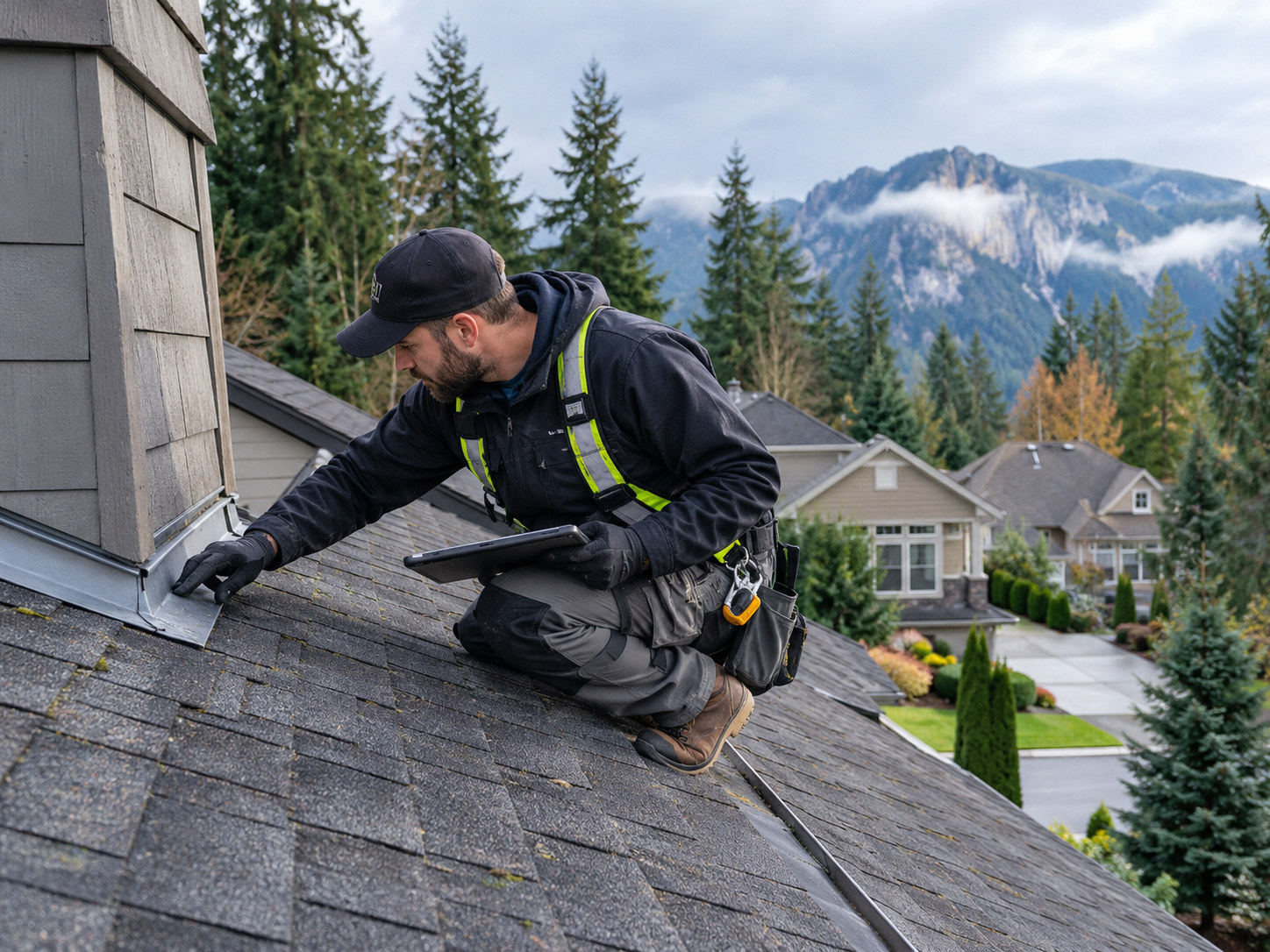
What Goes Into a New Commercial Roof in Seattle

When a Seattle building owner commits to a new commercial roof, the natural question is what the project actually involves. A commercial roof is not a single sheet laid over the building; it is a layered assembly installed in stages, each of which matters to how long the roof lasts. Understanding what goes into the installation, from the first assessment through the final inspection, helps an owner know what to expect, judge whether the work is being done properly, and see why the crew and the details make the difference. For commercial roofs across Seattle and the Eastside, here is what a proper installation involves.

Assessment and Planning

Every sound commercial roof installation starts before any material arrives, with an assessment of the building and the existing roof. The crew evaluates the roof's slope, size, and condition, the drainage, the rooftop equipment and penetrations, and the building's use, then recommends a system and lays out a plan. This stage is where the system choice is settled, whether a TPO or EPDM single-ply membrane, a modified bitumen or built-up system, or metal, and where the drainage design and insulation requirements are worked out to meet the Seattle Energy Code. Planning also covers permitting through the Seattle Department of Construction and Inspections and sequencing the work around the building's operations. A thorough plan at this stage is what keeps the installation on schedule and prevents surprises later.

Atlas Roofing treats this planning stage as the foundation of the project, assessing the building honestly and providing an itemized scope with no upselling, so the owner understands the system, the plan, and the reasons behind the recommendation before work begins. A realistic timeline comes out of this assessment, accounting for the building's size, the chosen system, the roof's complexity, and Seattle's weather windows, which matter in a climate where membrane and coating work needs dry conditions to bond correctly.

Tear-Off and the Deck

Where an old roof is being replaced, the installation usually begins with tear-off, removing the existing roofing down to the deck. This is often the stage that reveals the roof's true condition, because the deck has been hidden under the old roof and, on older Seattle buildings with a history of leaks, it frequently carries damage no one could see. Tear-off exposes rotted or delaminated decking, previous water damage, and structural issues that have to be addressed before the new roof goes on. A new membrane installed over a compromised deck will not last, so a proper installation inspects the exposed deck and repairs or replaces damaged sections first.

Atlas documents any deck damage found during tear-off with photos, so the owner sees exactly what was uncovered and why the repair is needed. This transparency matters because deck work is sometimes necessary beyond the original scope, and a repair-first, no-upselling contractor shows the owner the evidence rather than simply adding charges. Getting the deck sound is non-negotiable; it is the surface everything else is built on, and skipping it is how a new roof fails early despite a quality membrane on top.

Insulation and the Roof Assembly

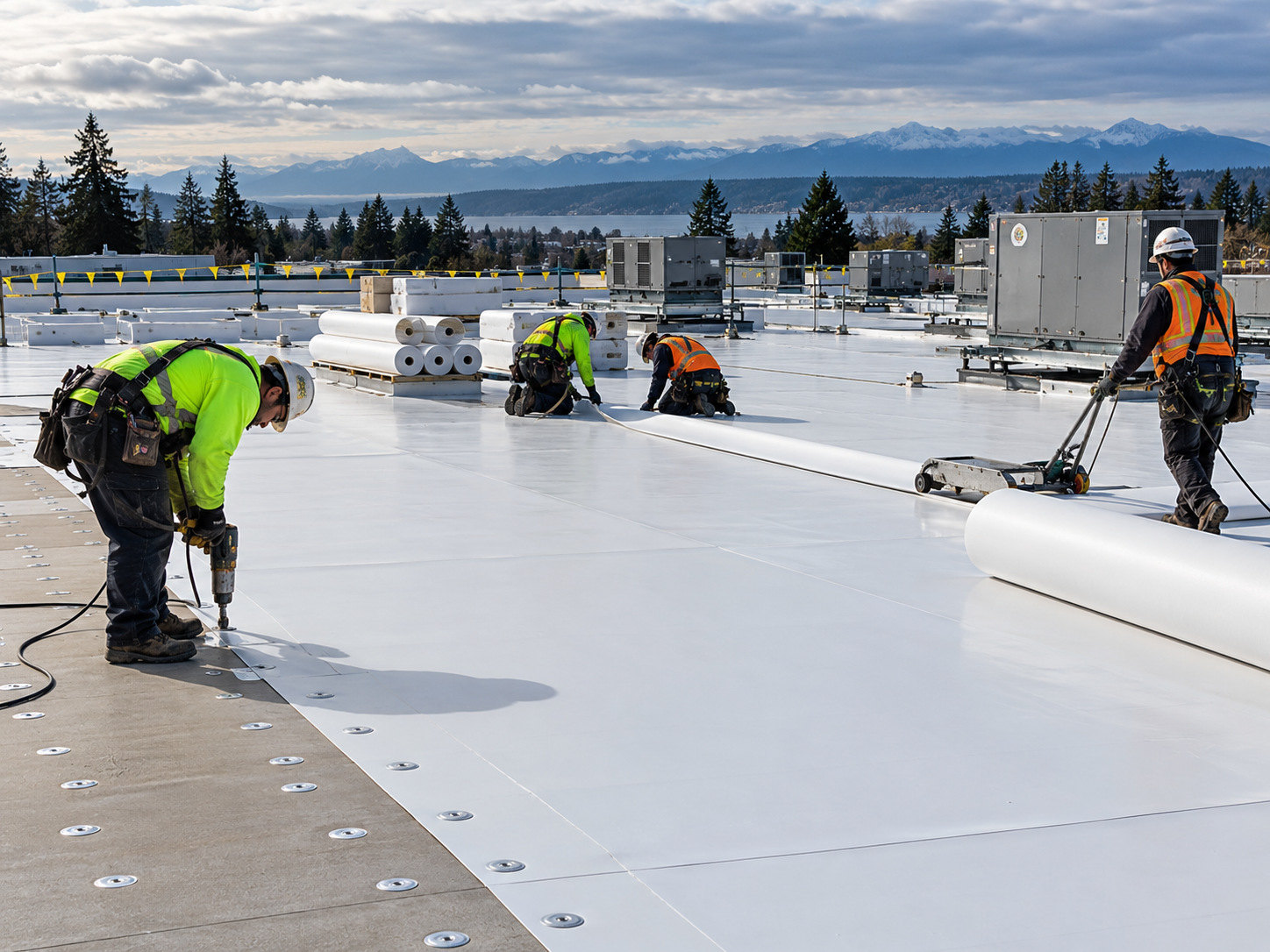
A commercial roof is a layered assembly, and once the deck is sound, the insulation goes on. Rigid insulation is installed over the deck to the values the Seattle Energy Code requires, often around R-38 for insulation above the deck in Seattle's Climate Zone 4C. This insulation layer is not optional; it is a code requirement, and it carries the roof's thermal performance while providing the even, prepared surface the membrane bonds or fastens to. The insulation is often tapered to build or improve slope toward the drains, which is central to managing Seattle's rain on a flat roof. How carefully the insulation is laid and the slope is built directly affects whether the finished roof drains or ponds.

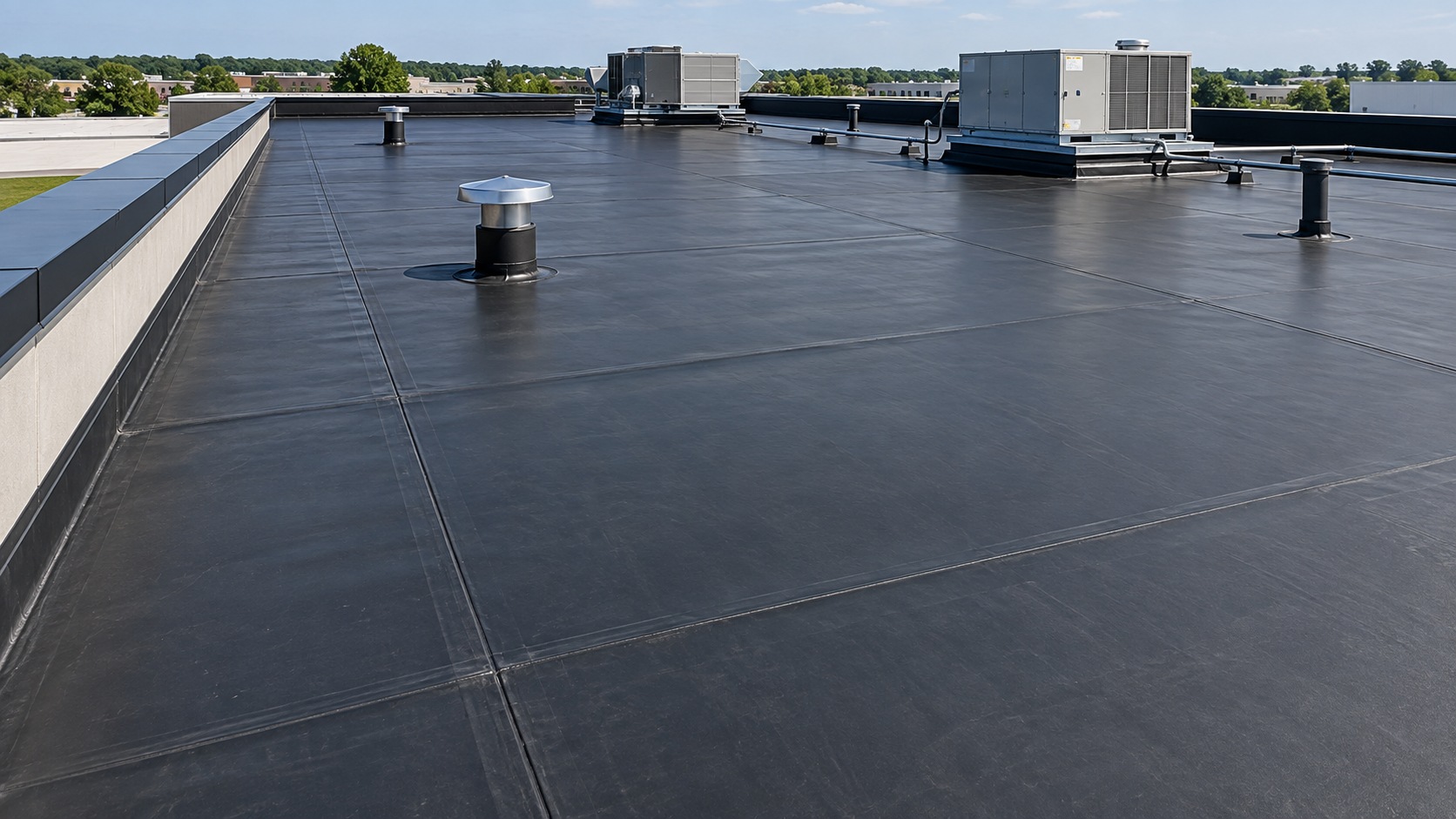
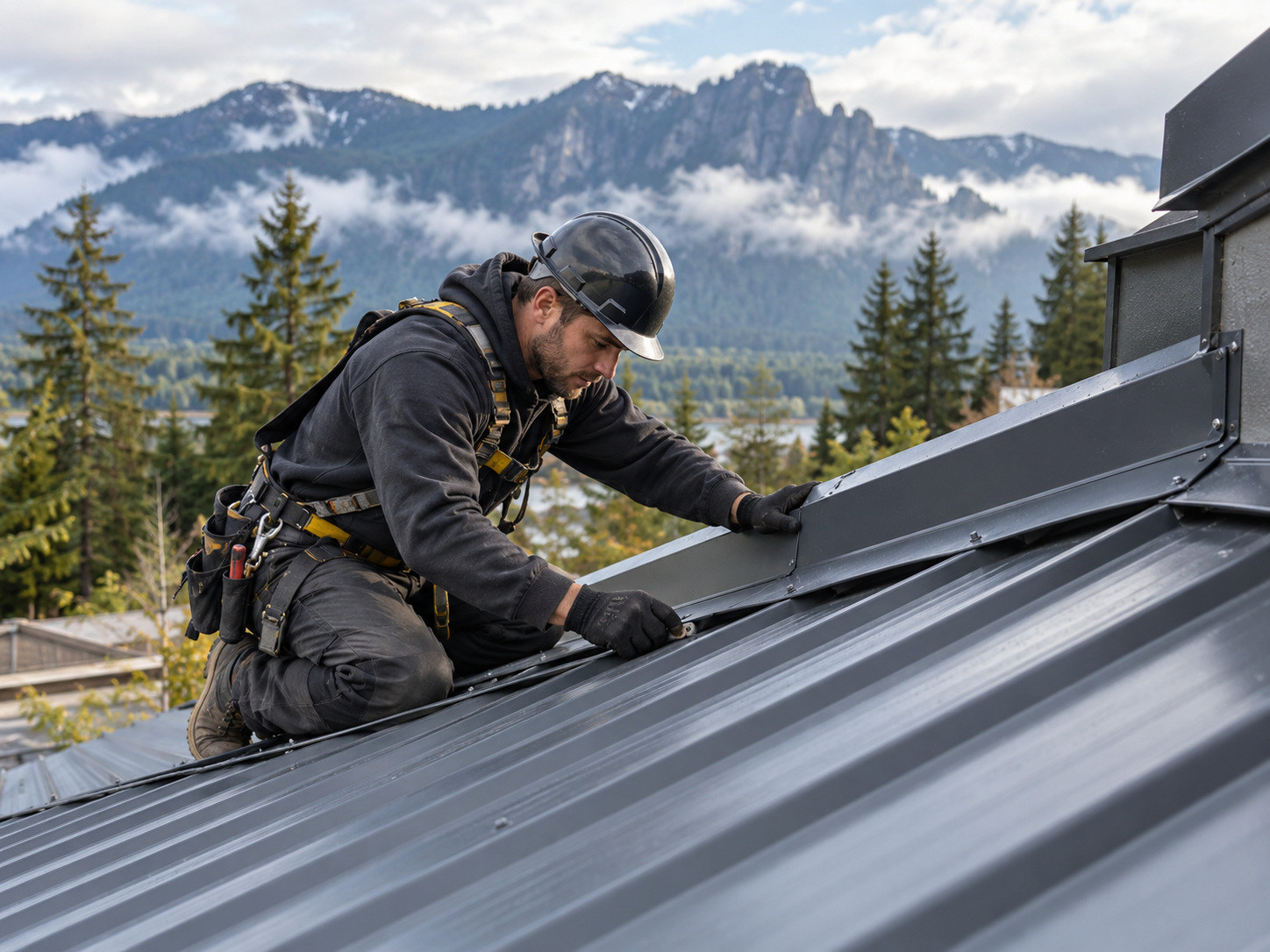
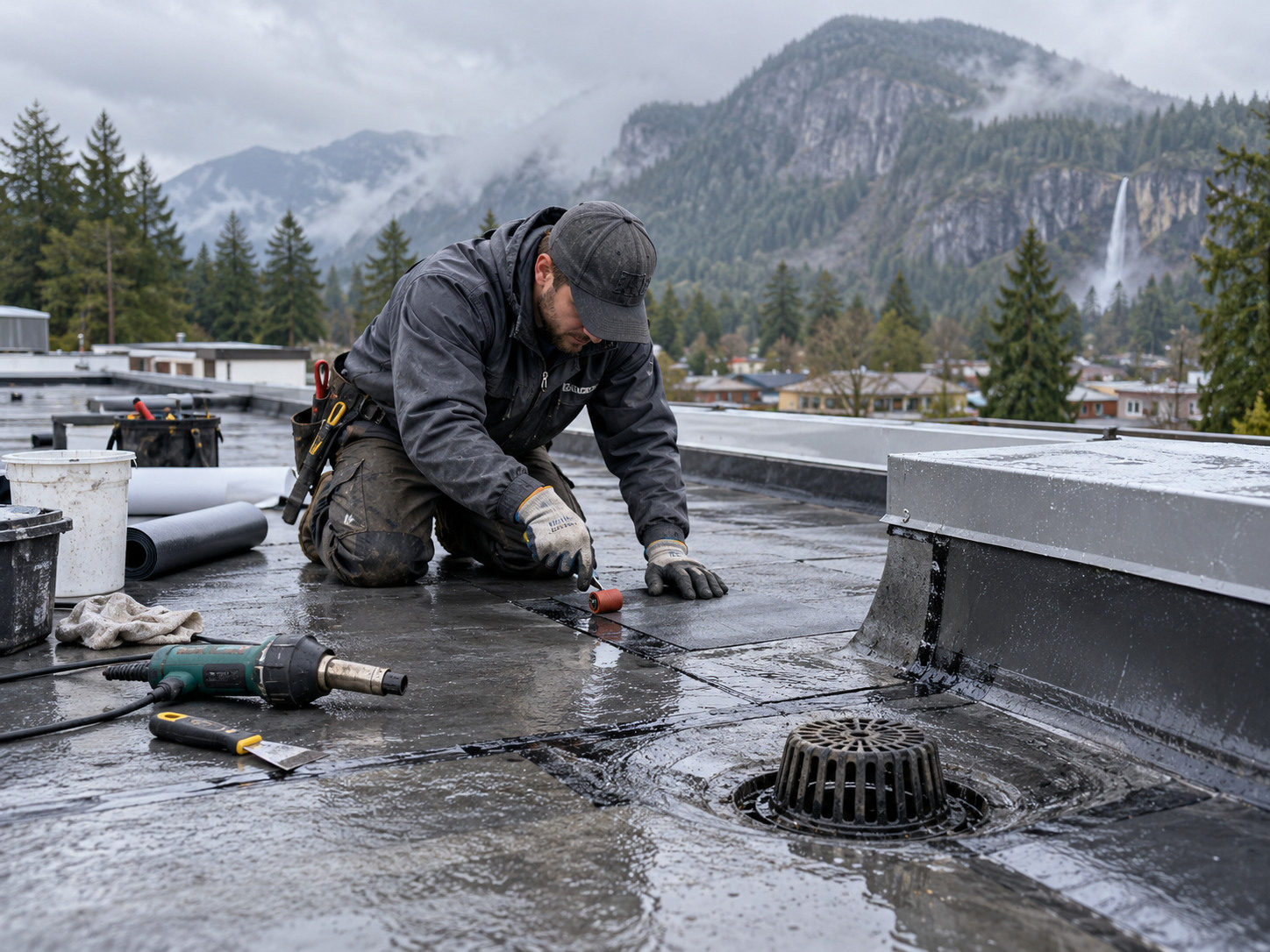
On top of the insulation comes the roofing system itself. For a single-ply membrane, large sheets of TPO or EPDM are rolled out and fastened or adhered, then the seams between sheets are heat-welded or bonded to form a continuous waterproof surface. For built-up or modified bitumen roofs, multiple plies are layered and set, by hot-mop or torch-down as the system calls for, building up redundant waterproofing. For metal, panels are installed and seamed. Each system has its own method, and the crew's experience with the specific system shows in the result, particularly at the seams, which are where a single-ply roof proves its quality or reveals its flaws.

What are the stages of a new commercial roof installation?

A commercial roof install moves through assessment and planning, permitting, tear-off of the old roof where needed, deck inspection and repair, insulation to code, membrane or system installation with welded or bonded seams, drainage and flashing detailing, and a final inspection. Atlas sequences these to keep the building protected and documents each stage with photos.

Will my business stay open during a commercial roof installation?

In most cases, yes. A commercial roof is installed from above, and crews sequence the work to keep the building protected and operations running, isolating active work areas and protecting the interior overnight. Atlas plans the sequence around the building's use and keeps the job site clean, so disruption to the business below is kept to a minimum.

What happens if the roof deck is damaged under the old roof?

Tear-off often reveals deck damage that was hidden under the old roof, especially on older Seattle buildings with past leaks. A proper installation inspects the exposed deck and repairs or replaces damaged sections before the new roof goes on, since a new membrane over a compromised deck will not last. Atlas documents any deck issues found with photos.

Drainage, Flashing, and Detailing

The membrane is only part of a watertight roof; the details finish it. Drainage is engineered into the installation through the slopes built with insulation and through the drains and scuppers that carry water off the roof, because on a Seattle flat roof, ponding water is the leading cause of early failure. Flashing is installed at every transition, where the roof meets walls, curbs, and parapets, and around every penetration, the rooftop HVAC units, vents, pipes, and skylights. These details are where water concentrates and where a roof is most likely to leak, so the quality of the flashing and penetration work is as important as the membrane itself.

Code-compliant detailing runs through this stage. The flashing heights, the drainage capacity, and the fire ratings all have to meet the Seattle building and energy codes, and the work is inspected to confirm it. Atlas handles this detailing to code and coordinates the required inspections, so the finished roof is compliant as well as watertight. The photo documentation continues through these stages, giving the owner a record of the drainage, flashing, and penetration work that is otherwise hard to see once the roof is finished.

Why the Crew Decides the Outcome

Every stage of a commercial roof installation depends on the crew doing it carefully, and this is where Atlas Roofing's in-house model matters. The crews are Atlas's own, OSHA-trained, not subcontracted, which means the same accountable team handles the tear-off, the deck repair, the insulation, the membrane, and the detailing to a consistent standard. Daily safety practices, clean job sites, magnetic sweeps, and daily debris removal keep the installation safe and the property protected throughout, which matters on a commercial site where operations continue below. For a project where a single poorly welded seam or badly flashed penetration can undermine the whole roof, having one accountable crew rather than a rotating cast of subcontractors is a real advantage.

Atlas is a licensed Washington contractor, license number ATLASRS758K1, bonded and insured, family-owned and veteran-led, and its crews are manufacturer-certified and work to manufacturer-approved methods, keeping the roof within its intended performance and warranty terms. The transparent, itemized, no-upselling approach and the photo documentation of every milestone give the owner visibility into a project that otherwise happens out of sight on the roof. For a new commercial roof that has to protect a Seattle building for decades, that accountability through every stage is what makes the installation sound.

Weather Windows and Scheduling the Work

Seattle's climate adds a scheduling dimension to a commercial roof installation that owners should understand. Many roofing operations, particularly the heat-welding of single-ply seams and the application of coatings, need a dry surface and a minimum temperature to bond correctly, and in a region with well over 150 rainy days a year, dry windows have to be planned for rather than assumed. A reputable contractor sequences the work to take advantage of favorable weather, protects the exposed roof and the building interior overnight and between work sessions, and keeps the structure watertight throughout a multi-day project. This is why the installation timeline accounts for weather and why a rushed job in poor conditions tends to show its flaws later at the seams.

The sequencing also protects the business operating below. A commercial roof is installed from above, and a careful crew isolates the active work area, protects the interior, and coordinates noisy or disruptive stages around the building's use, so the business can keep running during the project in most cases. Atlas Roofing plans the sequence around both the weather and the building's operations, keeps the job site clean with daily debris removal and magnetic sweeps, and holds the structure protected between stages. That planning is part of what separates a professional commercial installation from one that leaves a building exposed to a Seattle storm mid-project.

The Final Inspection and Handover

A commercial roof installation is not finished when the last of the membrane is down; it is finished when the roof has been inspected and the owner has what they need to maintain it. The final stage includes the required code inspections through the Seattle Department of Construction and Inspections, confirming that the insulation values, flashing, drainage, and fire ratings meet the applicable codes, and a walk of the finished roof to confirm the seams, penetrations, and drainage are sound. The photo documentation gathered through the project gives the owner a complete record of what was installed, from the condition of the deck at tear-off through the finished detailing, which is valuable both for warranty purposes and for future maintenance.

A proper handover also sets up the roof's future. The owner learns what system was installed, what maintenance it needs, and when to have it inspected, so the new roof is cared for rather than forgotten until a problem appears. Atlas Roofing closes a commercial installation with this documentation and guidance, and because the crews are manufacturer-certified and worked to manufacturer-approved methods, the roof keeps its intended performance and warranty standing. For an owner, a clear final inspection and handover is the assurance that the investment was installed correctly and is ready to protect the building for its full service life.

Seen whole, a commercial roof installation is a sequence of stages where each one depends on the last being done right, from the sound deck through the insulation, the membrane, the detailing, and the final inspection. An owner who understands that sequence can judge whether the work is being done properly and can see why the crew and the accountability behind it matter so much. A new commercial roof is a major investment, and it rewards an installer who treats every stage of it with the same care.

Getting a New Commercial Roof Done Right in Seattle

A new commercial roof is a layered, staged project, and every stage, the assessment, the deck, the insulation, the membrane, and the detailing, has to be done right for the roof to last. The sound first step is a consultation that assesses the building and lays out the plan honestly. Building owners across Seattle and the Eastside can reach Atlas Roofing Services for a free commercial roofing consultation and a code-compliant installation handled by in-house crews with photo-documented milestones. To plan a new commercial roof, call (425) 475-3795 or visit atlasroofingwa.com/commercial/new-roof-installation.


Seattle is located in the United States
Seattle
Seattle
Location within the United States
Seattle
dᶻidᶻəlal̕ič (Lushootseed)
 
Nicknames: 
The Emerald City, Jet City, Rain City
Mottoes: 
The City of Flowers, The City of Goodwill
Map
Interactive map of Seattle
Seattle is located in Washington (state)
Seattle
Seattle
Location within Washington (state)

Coordinates: 47°36′14″N 122°19′48″W / 47.60389°N 122.33000°W / 47.60389; -122.33000CountryUnited StatesStateWashingtonCountyKingFoundedNovember 13, 1851 (1851-11-13)[a]Incorporated (town status)January 14, 1865 (1865-01-14)Incorporated (city status)December 2, 1869 (1869-12-02)Named forChief SeattleGovernment


 • TypeMayor–council • BodySeattle City Council • MayorKatie WilsonArea

 • City

142.07 sq mi (367.97 km2) • Land83.99 sq mi (217.54 km2) • Water58.08 sq mi (150.43 km2) • Metro


8,186 sq mi (21,202 km2)Elevation

148 ft (45 m)Population

 • City

737,015

 • Estimate 
(2025)[3]

784,777 Increase • Rank54th in North America
18th in the United States
1st in Washington
 • Density9,302.2/sq mi (3,591.59/km2) • Urban

3,544,011 (US: 13th) • Urban density3,607/sq mi (1,392.7/km2) • Metro

4,018,762 (US: 15th)DemonymSeattleite[6] or Seattlite[7]GDP

 • Metro$604.065 billion (2024)Time zoneUTC−8 (PST) • Summer (DST)UTC−7 (PDT)ZIP Codes

ZIP Codes[10][11]

Area code206, 564FIPS code53-63000GNIS feature ID2411856[9]Websiteseattle.gov Edit this at Wikidata


Symbols


MottoThe City of Flowers; the City of Goodwill[12]Song"Seattle the Peerless City"[12]BirdGreat blue heron[12]FlowerDahlia[12]

Seattle (/siˈætəl/ ⓘ see-AT-əl) is the most populous city in the U.S. state of Washington and the Pacific Northwest region of North America. It is the 18th-most populous city in the United States with a population of 784,777 in 2025,[3] while the Seattle metropolitan area at over 4.15 million residents is the 15th-most populous metropolitan area in the nation.[13] The city is the county seat of King County, the most populous county in Washington. Seattle's growth rate of 21.1% between 2010 and 2020 made it one of the country's fastest-growing large cities.[14]

Seattle is situated on an isthmus between Puget Sound, an inlet of the Pacific Ocean, and Lake Washington. It is the northernmost major city in the United States, located about 100 miles (160 km) south of the Canadian border. A gateway for trade with the Asia-Pacific region, the Port of Seattle is the fourth-largest port in North America in terms of container handling as of 2021.[15]

The Seattle area has been inhabited by Native Americans (such as the Duwamish, who had at least 17 villages around Elliott Bay) for at least 4,000 years before the arrival of the first permanent European settlers.[16] Arthur A. Denny and his group of travelers, subsequently known as the Denny Party, arrived from Illinois via Portland, Oregon, on the schooner Exact at Alki Point on November 13, 1851.[17] The settlement was moved to the eastern shore of Elliott Bay in 1852 and named "Seattle" in honor of Chief Seattle, a prominent 19th-century leader of the local Duwamish and Suquamish tribes. Seattle has relatively high populations of Native Americans as well as Americans with strong Asian, African, and European ancestry, and, as of 2015, has the fifth-highest percentage of residents who identify as LGBT among major metropolitan areas in the U.S. (4.8 percent).[18]

Logging was Seattle's first major industry, but by the late 19th century the city had become a commercial and shipbuilding center as a gateway to Alaska during the Klondike Gold Rush. The city grew after World War II, partly due to the local company Boeing, which established Seattle as a center for its manufacturing of aircraft. Beginning in the 1980s, the Seattle area developed into a technology center; Microsoft established its headquarters in the region. Alaska Airlines is based at Seattle–Tacoma International Airport in nearby SeaTac. The rise of new software, biotechnology, and Internet companies led to an economic revival, which increased the city's population by almost 50,000 between 1990 and 2000.

The culture of Seattle is heavily defined by its significant musical history. Between 1918 and 1951, nearly 24 jazz nightclubs existed along Jackson Street, from the current Chinatown/International District to the Central District. The jazz scene nurtured the early careers of Ernestine Anderson, Ray Charles, Quincy Jones, and others. In the late 20th and early 21st centuries, the city was the origin of several rock artists and bands, including the Foo Fighters, Heart, and Jimi Hendrix, and the subgenre of grunge and its pioneering bands, including Alice in Chains, Nirvana, Pearl Jam, and Soundgarden.[19]

History

[edit]

Archaeological excavations suggest that Native Americans have inhabited the Seattle area for at least 4,000 years.[16] By the time the first European settlers arrived, the Duwamish people occupied at least 17 villages in the areas around Elliott Bay.[20][21][22] The name for the modern city of Seattle in Lushootseed, dᶻidᶻəlal̓ič, meaning "little crossing-over place", comes from one of these villages, which was located at the present-day King Street Station.[23][24][25]

In May 1792, George Vancouver was the first European to visit the Seattle area during his 1791–1795 expedition for the Royal Navy, which sought to chart the Pacific Northwest for the British.[26]

19th century

[edit]
Seattle's first streetcar at the corner of Occidental and Yesler in 1884; all buildings depicted were destroyed by the Great Seattle Fire five years later, in 1889.
An 1891 aerial view of Seattle and surrounding King County[27]

In 1851, a large party of American pioneers led by Luther Collins made a location on land at the mouth of the Duwamish River; they formally claimed it on September 14, 1851.[28] Thirteen days later, members of the Collins Party on the way to their claim passed three scouts of the Denny Party.[29] Members of the Denny Party claimed land on Alki Point on September 28, 1851.[30] The rest of the Denny Party set sail on the schooner Exact from Portland, Oregon, stopping in Astoria, and landed at Alki Point during a rainstorm on November 13, 1851.[30] After a difficult winter, most of the Denny Party relocated across Elliott Bay and claimed land a second time at the site of present-day Pioneer Square,[30] naming this new settlement Duwamps.[31]

Charles Terry and John Low remained at the original landing location, reestablished their old land claim and called it "New York", but renamed "New York Alki" in April 1853, from a Chinook word meaning, roughly, "by and by" or "someday".[32][33] For the next few years, New York Alki and Duwamps competed for dominance, but in time Alki was abandoned and its residents moved across the bay to join the rest of the settlers.[34]

David Swinson "Doc" Maynard, one of the founders of Duwamps, was the primary advocate to name the settlement after Chief Seattle (Lushootseed: siʔaɫ, anglicized as "Seattle"), chief of the Duwamish and Suquamish tribes.[35][36][37] The brief Puget Sound War culminated in the Battle of Seattle on January 26, 1856. The attack was repelled, and the settlement was never attacked again.[38]

The name "Seattle" appears on official Washington Territory papers dated May 23, 1853, when the first plats for the village were filed. In 1855, nominal land settlements were established. On January 14, 1865, the Legislature of Territorial Washington incorporated the Town of Seattle with a board of trustees managing the city. The Town of Seattle was disincorporated on January 18, 1867, and remained a mere precinct of King County until late 1869, when a new petition was filed and the city was re-incorporated December 2, 1869, with a mayor–council government.[30][39] The corporate seal of the City of Seattle carries the date "1869" and a likeness of Chief Seattle in left profile.[40] That same year, Seattle acquired the epithet of the "Queen City", a designation officially changed in 1982 to the "Emerald City".[41]

Seattle has a history of boom-and-bust cycles, like many other cities near areas of extensive natural and mineral resources. Seattle has risen several times economically, then gone into precipitous decline, but it has typically used those periods to rebuild solid infrastructure.[42]

The first such boom, covering the early years of the city, rode on the lumber industry. During this period the road now known as Yesler Way won the nickname "Skid Road", supposedly after the timber skidding down the hill to Henry Yesler's sawmill. The later dereliction of the area may be a possible origin for the term which later entered the wider American lexicon as Skid Row.[43] Like much of the Western United States, Seattle experienced conflicts between labor and management and ethnic tensions that culminated in the anti-Chinese riots of 1885–1886.[44] This violence originated with unemployed whites who were determined to drive the Chinese from Seattle; anti-Chinese riots also occurred in Tacoma.

Seattle had achieved sufficient economic success when the Great Seattle Fire of 1889 destroyed the central business district. However, a far grander city center rapidly emerged in its place.[45] Finance company Washington Mutual, for example, was founded in the immediate wake of the fire.[46] The Panic of 1893 hit Seattle hard.[47]

The second and most dramatic boom resulted from the Klondike Gold Rush, which ended the depression that had begun with the Panic of 1893. In a short time, Seattle became a major transportation center. On July 14, 1897, the S.S. Portland docked with its famed "ton of gold", and Seattle became the main transport and supply point for the miners in Alaska and the Yukon. Few of those working men found lasting wealth. However, it was Seattle's business of clothing the miners and feeding them salmon that panned out in the long run. Along with Seattle, other cities like Everett, Tacoma, Port Townsend, Bremerton, and Olympia, all in the Puget Sound region, became competitors for exchange, rather than mother lodes for extraction, of precious metals.[48]

 
A September 1870 engraving of Seattle published in Harper's Magazine

20th century

[edit]
Pioneer Square, the Pioneer Building, the Smith Tower, and the Seattle Hotel in 1917
The Seattle Center Monorail under construction in 1961

The boom lasted into the early part of the 20th century, and funded many new Seattle companies and products. In 1907, 19-year-old James E. Casey borrowed $100 from a friend and founded the American Messenger Company (later UPS). Other Seattle companies founded during this period include Nordstrom and Eddie Bauer.[46] Seattle brought in the Olmsted Brothers landscape architecture firm to design a system of parks and boulevards.[49] The Gold Rush era culminated in the Alaska–Yukon–Pacific Exposition of 1909, which is largely responsible for the layout of today's University of Washington campus.[50]

A shipbuilding boom in the early part of the 20th century became massive during World War I, making Seattle somewhat of a company town. The subsequent retrenchment led to the Seattle General Strike of 1919, an early general strike in the country.[51] A 1912 city development plan by Virgil Bogue went largely unused. Seattle was mildly prosperous in the 1920s but was particularly hard hit in the Great Depression, experiencing some of the country's harshest labor strife in that era. Violence during the Maritime Strike of 1934 cost Seattle much of its maritime traffic, which was rerouted to the Port of Los Angeles.[52]

Seattle was one of the major cities that benefited from programs such as the Works Progress Administration, CCC, Public Works Administration, and others.[53][54] The workers, mostly men, built roads, parks, dams, schools, railroads, bridges, docks, and even historical and archival record sites and buildings. Seattle faced significant unemployment, loss of lumber and construction industries as Los Angeles prevailed as the bigger West Coast city. Seattle had building contracts that rivaled New York City and Chicago, but also lost to Los Angeles. Seattle's eastern farm land faded due to Oregon's and the Midwest's, forcing people into town.[55][56]

Hooverville arose during the Depression, leading to Seattle's growing homeless population. Stationed outside Seattle, the Hooverville housed thousands of men but very few children and no women. With work projects close to the city, Hooverville grew and the WPA settled into the city.[57]

A movement of women arose from Seattle during the Great Depression, fueled in part by Eleanor Roosevelt's 1933 book It's Up to the Women; women pushed for recognition, not just as housewives, but as the backbone of the family. Using newspapers and journals Working Woman and The Woman Today, women pushed to be seen as equal and receive some recognition.[58]

The Great Depression did not impact the University of Washington negatively. As schools across Washington lost funding and attendance, the university actually prospered during the time period as they focused on growing their student enrollment. While Seattle public schools were influenced by Washington's superintendent Worth McClure,[59] they still struggled to pay teachers and maintain attendance.[60]

Seattle was the home base of impresario Alexander Pantages who, starting in 1902, opened a number of theaters in the city exhibiting vaudeville acts and silent movies. He went on to become one of America's greatest theater and movie tycoons. Scottish-born architect B. Marcus Priteca designed several theaters for Pantages in Seattle, which were later demolished or converted to other uses. Seattle's surviving Paramount Theatre, on which he collaborated, was not a Pantages theater.[61]

War work again brought local prosperity during World War II, centered on the production of Boeing aircraft. The war dispersed the city's numerous Japanese-American businessmen due to the Japanese American internment. After the World War II, however, the local economy dipped. It rose again with Boeing's growing dominance in the commercial airliner market.[62] Seattle celebrated its restored prosperity and made a bid for world recognition with the Century 21 Exposition, the 1962 World's Fair, for which the Space Needle was built.[63]

Another major local economic downturn was in the late 1960s and early 1970s, at a time when Boeing was heavily affected by the oil crises, loss of government contracts, and costs and delays associated with the Boeing 747. Many people left the area to look for work elsewhere, and two local real estate agents put up a billboard reading "Will the last person leaving Seattle – Turn out the lights."[64]

747 prototype "City of Everett" at Museum of Flight in Seattle.

Seattle remained the corporate headquarters of Boeing until 2001, when the company separated its headquarters from its major production facilities; the headquarters were moved to Chicago.[65] The Seattle area is still home to Boeing's Renton narrow-body plant and Everett wide-body plant.[66] The company's credit union for employees, BECU, remains based in the Seattle area and has been open to all residents of Washington since 2002.[67]

On March 20, 1970, twenty-eight people were killed when the Ozark Hotel was burned by an unknown arsonist.[68] The Wah Mee massacre in 1983 resulted in the killing of 13 people in an illegal gambling club in the Seattle Chinatown-International District.[69]

The city's first coffeehouses were established in the late 1950s and grew over the following decades as espresso was introduced to the American market. On March 30, 1971, the first location for Starbucks Coffee opened at Pike Place Market in Downtown Seattle. The company initially sold coffee beans but later expanded into cafes.[70]

Prosperity began to return in the 1980s beginning with Microsoft's 1979 move from Albuquerque, New Mexico, to nearby Bellevue, Washington.[71]

Seattle and its suburbs became home to a number of technology companies, including Amazon, F5 Networks, RealNetworks, Nintendo of America, and T-Mobile.[72] This success brought an influx of new residents with a population increase within city limits of almost 50,000 between 1990 and 2000,[73] and saw Seattle's real estate become some of the most expensive in the country.[74]

Seattle in this period attracted attention as home to the companies opened operations in or around the city. In 1990, the Goodwill Games were held in the city.[75] Three years later, in 1993, the APEC leaders was hosted in Seattle.[76] The 1990s also witnessed a growing popularity in grunge music, a sound that was largely developed in Seattle's independent music scene.[77]

In 1993, the movie Sleepless in Seattle brought the city further national attention,[78] as did the television sitcom Frasier. The dot-com boom caused a great frenzy among the technology companies in Seattle but the bubble ended in early 2001.[79][80]

In 1999, the World Trade Organization held its conference in Seattle, which was met with protest activity. The protests and police reactions to them largely overshadowed the conference itself.[81]

21st century

[edit]

In 2001, the city was impacted by the Mardi Gras Riots and then by the Nisqually earthquake the following day.[82]

Another boom began as the city emerged from the Great Recession, commencing when Amazon moved its headquarters from North Beacon Hill to South Lake Union. The move initiated a historic construction boom which resulted in the completion of almost 10,000 apartments in Seattle in 2017, more than any previous year and nearly twice as many as were built in 2016.[83][84] By 2025, Seattle's new apartments had become the smallest in the U.S., with an average of 649 square feet (60.3 m2) among all unit types.[85]

From 2010 to 2015, Seattle gained an average of 14,511 residents per year, with the growth strongly skewed toward the center of the city,[86] and unemployment dropped from roughly 9 percent to 3.6 percent.[87] The city has found itself "bursting at the seams", with over 45,000 households spending more than half their income on housing and at least 2,800 people homeless, and with the country's sixth-worst rush-hour traffic.[87] In response, many urbanist measures to improve transit, cycling,[88] and housing affordability were passed by city council, the state, and voters.[89] These include Sound Transit 3, Seattle Prop 1A,[90] a new "One Seattle" Comprehensive Plan,[91] and electing Katie Wilson to mayor.

In 2020, protesters against the murder of George Floyd and police over-funding established a self-declared autonomous zone in the Capitol Hill neighborhood of Seattle.[92]

During the early to mid 2020s, large numbers of transgender people fled to Seattle from conservative-leaning states, which had implemented hostile legislation restricting their civil rights. This led the city's LGBTQ commission to send a letter to the mayor recommending a state of civil emergency be declared.[93][94][95]

Geography

[edit]

Topography

[edit]
A satellite photo of Seattle in September 2018

Seattle is located between the saltwater Puget Sound (an arm of the Pacific Ocean) to the west and Lake Washington to the east. The city's chief harbor, Elliott Bay, is part of Puget Sound, making the city an oceanic port. To the west, beyond Puget Sound, are the Kitsap Peninsula and Olympic Mountains on the Olympic Peninsula; to the east, beyond Lake Washington and the Eastside suburbs, are Lake Sammamish and the Cascade Range. Lake Washington's waters flow to Puget Sound through the Lake Washington Ship Canal (consisting of two man-made canals, Lake Union, and the Hiram M. Chittenden Locks at Salmon Bay, ending in Shilshole Bay on Puget Sound).[citation needed]

The sea, rivers, forests, lakes, and fields surrounding Seattle were once rich enough to support one of the world's few sedentary hunter-gatherer societies. In modern times the surrounding area lends itself well to sailing, skiing, bicycling, camping, and hiking year-round.[96][97]

The city is hilly in some places.[98] Like Rome, the city is said to lie on seven hills;[99] the lists vary but typically include Capitol Hill, First Hill, West Seattle, Beacon Hill, Queen Anne, Magnolia, and the former Denny Hill. The Wallingford, Delridge, Mount Baker, Seward Park, Washington Park, Broadmoor, Madrona, Phinney Ridge, Sunset Hill, Blue Ridge, Broadview, Laurelhurst, Hawthorne Hills, Maple Leaf, and Crown Hill neighborhoods are all located on hills. Many of the hilliest areas are near the city center, with Capitol Hill, First Hill, and Beacon Hill collectively constituting something of a ridge along an isthmus between Elliott Bay and Lake Washington.[100] The break in the ridge between First Hill and Beacon Hill is man-made, a result of two of the many regrading projects that reshaped the topography of the city center.[101] The topography of the city center was also changed by the construction of a seawall and the artificial Harbor Island (completed 1909) at the mouth of the city's industrial Duwamish Waterway, the terminus of the Green River. The highest point within city limits, 520 feet (160 m) above sea level, is at Myrtle Reservoir Park in the High Point neighborhood of West Seattle.[102]

North of the city center, the Lake Washington Ship Canal connects Puget Sound to Lake Washington. It incorporates four natural bodies of water: Lake Union, Salmon Bay, Portage Bay, and Union Bay.[103]

Due to its location in the Pacific Ring of Fire, Seattle is in a major earthquake zone. On February 28, 2001, the magnitude 6.8 Nisqually earthquake did significant architectural damage, especially in the Pioneer Square area (built on reclaimed land, as are the Industrial District and part of the city center), and caused one fatality.[104] Other strong earthquakes occurred on January 26, 1700 (estimated at 9 magnitude), December 14, 1872 (7.3 or 7.4),[105] April 13, 1949 (7.1),[106] and April 29, 1965 (6.5).[107] The 1965 quake caused three deaths in Seattle directly and one more by heart failure.[107] Although the Seattle Fault passes just south of the city center, neither it[108] nor the Cascadia subduction zone has caused an earthquake since the city's founding. The Cascadia subduction zone poses the threat of an earthquake of magnitude 9.0 or greater, capable of seriously damaging the city and collapsing many buildings, especially in zones built on fill.[109]

According to the U.S. Census Bureau, the city has a total area of 142.5 square miles (369 km2),[110] 84 square miles (220 km2) of which is land and 58.1 square miles (150 km2) is water (41% of the total area).[1]

Cityscape

[edit]
 
A Seattle skyline view from Queen Anne Hill, including the Space Needle, Climate Pledge Arena, Mount Rainier, Elliott Bay, and the Port of Seattle on Puget Sound

Climate

[edit]

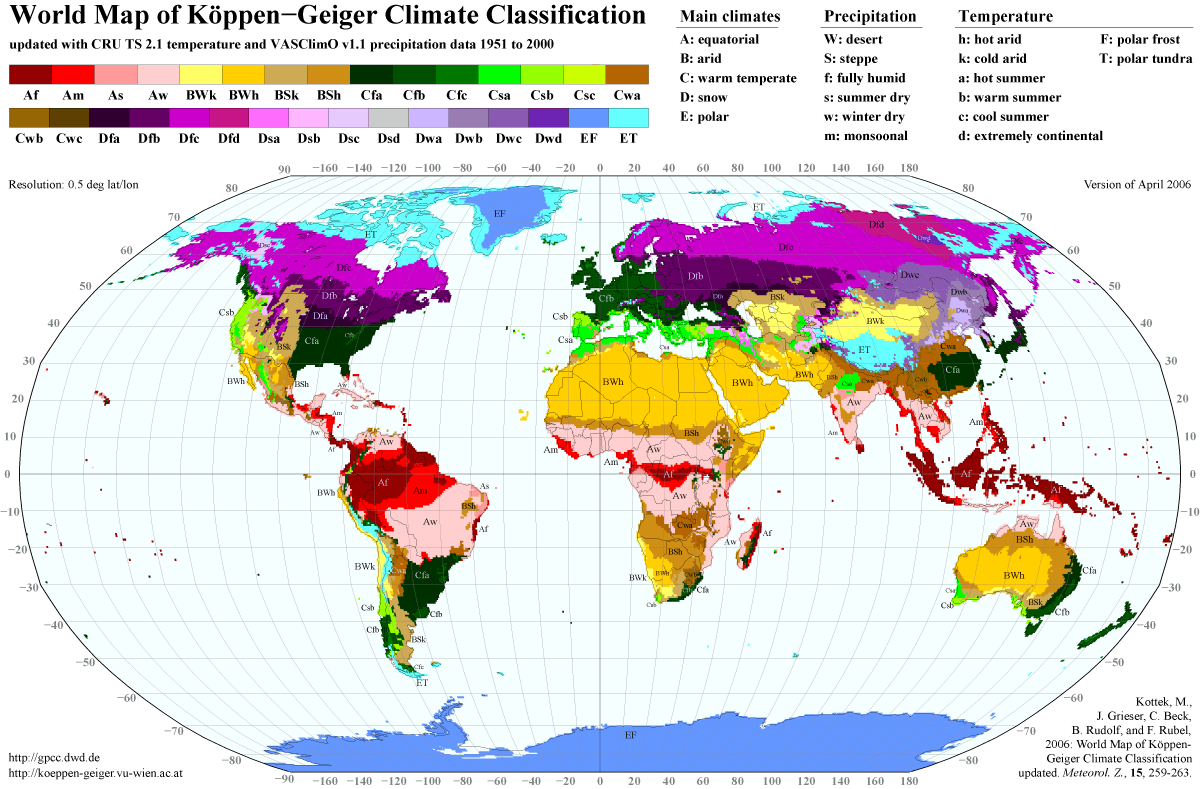
According to the Köppen climate classification system, Seattle has a warm-summer Mediterranean climate (Csb),[111][112][113] while under the Trewartha system, it is labeled an oceanic climate (Dobk).[114][115] It has cool, wet winters and mild, relatively dry summers, covering characteristics of both climate types.[116][117] The climate is sometimes characterized as a "modified Mediterranean" climate because it is cooler and wetter than a "true" Mediterranean climate, but shares the characteristic dry summer (which has a strong influence on the region's vegetation).[118]

Seattle's strong seasonal contrast reflects the migration of the dominant North Pacific pressure centers. In summer, the North Pacific High expands northward over the eastern Pacific and deflects the storm track far to the north of Washington.[119] From late autumn through early spring the high retreats southward while the Aleutian Low, a semi-permanent low-pressure system near the Aleutian Islands, intensifies and shifts south, becoming one of the dominant features of Northern Hemisphere atmospheric circulation.[119][120] Extratropical cyclones forming in the sub-polar North Pacific typically reach peak intensity near the Aleutian Low and are then steered by the polar jet stream toward the Pacific Northwest coast, delivering the great majority of Seattle's annual precipitation between October and March.[120] Particularly intense storms include atmospheric rivers ("Pineapple Express" systems) that channel subtropical moisture into western Washington and can produce four to five inches of rainfall in twenty-four hours.[121]

The city's precipitation is further shaped by its position in the lee of the Olympic Mountains, which rise abruptly to nearly 8,000 feet (2,400 m) only about 60 miles (97 km) to the west and force orographic uplift of incoming Pacific air. The windward Hoh Rainforest averages roughly 142 inches (3,600 mm) of precipitation annually, while the rain shadow on the leeward side produces only about 16 inches (410 mm) at Sequim in the Dungeness Valley, one of the steepest precipitation gradients in the contiguous United States.[122][123] Seattle sits near the eastern edge of this shadow and is only partially sheltered by it.

Temperature extremes are moderated by the adjacent Puget Sound, greater Pacific Ocean, and Lake Washington. Thus extreme heat waves are rare in the Seattle area, as are very cold temperatures (below about 15 °F; −9 °C). The Seattle area is the cloudiest region of the Continental United States, with 201 cloudy days and 93 partly cloudy days in an average year.[124] With many more "rain days" than other major American cities, Seattle has a well-earned reputation for frequent rain.[123] In an average year, there are 150 days in which at least 0.01 inches (0.25 mm) of precipitation falls, more days than in nearly all U.S. cities east of the Rocky Mountains.[125] However, because it often has merely a light drizzle falling from the sky for many days, Seattle actually receives significantly less rainfall (or other precipitation) overall than many other major U.S. cities like New York City, Miami, or Houston.

The most damaging weather events in the region are deep extratropical cyclones spawned along the Aleutian Low storm track, which periodically produce some of the strongest non-tropical windstorms in the contiguous United States.[126] The benchmark event is the Columbus Day storm of 1962, which brought sustained winds above 100 miles per hour (160 km/h) to western Washington and killed 46 people across the region; the Hanukkah Eve Wind Storm of 2006 cut power to approximately 1.8 million customers and caused damages exceeding $1 billion.[127]

Month Jan Feb Mar Apr May Jun Jul Aug Sep Oct Nov Dec Year
Record high °F (°C) 67
(19)
70
(21)
79
(26)
89
(32)
93
(34)
108
(42)
103
(39)
99
(37)
98
(37)
89
(32)
74
(23)
66
(19)
108
(42)
Mean maximum °F (°C) 57.0
(13.9)
59.1
(15.1)
66.4
(19.1)
74.3
(23.5)
81.9
(27.7)
85.8
(29.9)
91.2
(32.9)
89.9
(32.2)
84.1
(28.9)
72.0
(22.2)
61.6
(16.4)
56.8
(13.8)
94.1
(34.5)
Mean daily maximum °F (°C) 48.0
(8.9)
50.3
(10.2)
54.2
(12.3)
59.3
(15.2)
66.3
(19.1)
71.1
(21.7)
77.4
(25.2)
77.6
(25.3)
71.6
(22.0)
60.5
(15.8)
52.1
(11.2)
47.0
(8.3)
61.3
(16.3)
Daily mean °F (°C) 42.8
(6.0)
44.0
(6.7)
47.1
(8.4)
51.3
(10.7)
57.5
(14.2)
62.0
(16.7)
67.1
(19.5)
67.4
(19.7)
62.6
(17.0)
53.8
(12.1)
46.5
(8.1)
42.0
(5.6)
53.7
(12.1)
Mean daily minimum °F (°C) 37.7
(3.2)
37.7
(3.2)
39.9
(4.4)
43.3
(6.3)
48.7
(9.3)
53.0
(11.7)
56.8
(13.8)
57.2
(14.0)
53.6
(12.0)
47.0
(8.3)
40.9
(4.9)
37.1
(2.8)
46.1
(7.8)
Mean minimum °F (°C) 26.1
(−3.3)
27.3
(−2.6)
31.3
(−0.4)
35.6
(2.0)
40.6
(4.8)
46.6
(8.1)
51.5
(10.8)
51.7
(10.9)
45.8
(7.7)
36.8
(2.7)
29.2
(−1.6)
25.4
(−3.7)
21.5
(−5.8)
Record low °F (°C) 0
(−18)
1
(−17)
11
(−12)
29
(−2)
28
(−2)
38
(3)
43
(6)
44
(7)
35
(2)
28
(−2)
6
(−14)
6
(−14)
0
(−18)
Average precipitation inches (mm) 5.78
(147)
3.76
(96)
4.17
(106)
3.18
(81)
1.88
(48)
1.45
(37)
0.60
(15)
0.97
(25)
1.61
(41)
3.91
(99)
6.31
(160)
5.72
(145)
39.34
(999)
Average snowfall inches (cm) 1.8
(4.6)
2.2
(5.6)
0.4
(1.0)
0.0
(0.0)
0.0
(0.0)
0.0
(0.0)
0.0
(0.0)
0.0
(0.0)
0.0
(0.0)
0.0
(0.0)
0.2
(0.51)
1.7
(4.3)
6.3
(16)
Average precipitation days (≥ 0.01 in) 18.7 15.9 17.1 15.0 11.3 9.2 4.7 4.9 8.3 14.3 18.4 18.4 156.2
Average snowy days (≥ 0.1 in) 1.4 1.2 0.4 0.0 0.0 0.0 0.0 0.0 0.0 0.0 0.2 1.5 4.7
Average relative humidity (%) 78.0 75.2 73.6 71.4 68.9 67.1 65.4 68.2 73.2 78.6 79.8 80.1 73.3
Average dew point °F (°C) 33.1
(0.6)
35.1
(1.7)
36.3
(2.4)
38.8
(3.8)
43.5
(6.4)
48.2
(9.0)
51.4
(10.8)
52.7
(11.5)
50.2
(10.1)
45.1
(7.3)
38.8
(3.8)
34.3
(1.3)
42.3
(5.7)
Mean monthly sunshine hours 69.8 108.8 178.4 207.3 253.7 268.4 312.0 281.4 221.7 142.6 72.7 52.9 2,169.7
Percentage possible sunshine 25 38 48 51 54 56 65 64 59 42 26 20 49
Average ultraviolet index 0.8 1.5 2.8 4.5 6.0 6.9 7.3 6.2 4.4 2.3 1.1 0.7 3.7
Source 1: NOAA (relative humidity, dew point and sun 1961–1990)[128][129][130]
Source 2: UV Index Today (1995 to 2022)[131]

Demographics

[edit]

In the 2012–2016 American Community Survey (ACS), the racial makeup of the city was 65.7% White Non-Hispanic, 16.9% Asian, 6.8% Black or African American, 6.6% Hispanic or Latino of any race, 0.4% Native American, 0.9% Pacific Islander, 0.2% other races, and 5.6% two or more races.[132]

Historical population
Census Pop. Note %±
1860 188   —
1870 1,107   488.8%
1880 3,533   219.2%
1890 42,837   1,112.5%
1900 80,671   88.3%
1910 237,194   194.0%
1920 315,312   32.9%
1930 365,583   15.9%
1940 368,302   0.7%
1950 467,591   27.0%
1960 557,087   19.1%
1970 530,831   −4.7%
1980 493,846   −7.0%
1990 516,259   4.5%
2000 563,374   9.1%
2010 608,660   8.0%
2020 737,015   21.1%
2025 (est.) 784,777 [3] Increase 6.5%
U.S. Decennial Census[133]
2010–2020[2]
Racial composition 2024[134] 2020[135] 2010[136] 1990[137] 1970[137] 1950[137] 1940[137]
White (non-Hispanic) 56.9% 59.5% 66.3% 73.7% 85.3%[d] 94.2%[e] 96.1%[e]
Asian and Pacific Islander combined (non-Hispanic) 18.1% 17.2% 14.1% 11.8%[e] 4.2%[e] 1.8%[e] 2.8%[e]
Hispanic or Latino of any race 9.1% 8.2% 6.6% 3.6% 2.0%[d] n/a[e] n/a[e]
Black or African American (non-Hispanic) 6.7% 6.8% 7.7% 10.1%[e] 7.1%[e] 3.4%[e] 1.0%[e]
Native American (non-Hispanic) 0.3% 0.4% 0.6% 1.4%[e] 0.8%[e] 0.1%[e] 0.1%[e]
Some Other Race (non-Hispanic) 0.5% 0.6% 0.2% 1.4%[e] 0.5%[e] 0.5%[e] n/a
Two or more races (non-Hispanic) 8.4% 7.3% 4.4% n/a n/a n/a n/a

Seattle's population historically has been predominantly white.[137] The 2010 census showed that Seattle was one of the whitest big cities in the country, although its proportion of white residents has been gradually declining.[138] In 1960, whites constituted 91.6% of the city's population,[137] while in 2010 they constituted 69.5%.[139][140] According to the 2006–2008 American Community Survey, approximately 78.9% of residents over the age of five spoke only English at home. Those who spoke Asian languages other than Indo-European languages made up 10.2% of the population, Spanish was spoken by 4.5% of the population, speakers of other Indo-European languages made up 3.9%, and speakers of other languages made up 2.5%.[citation needed]

Ethnic origins in Seattle
A racial distribution map of Seattle, 2010 U.S. Census. Each dot is 25 people: ⬤ White

⬤ Black

⬤ Asian

⬤ Hispanic

⬤ Other

Seattle's foreign-born population grew 40% between the 1990 and 2000 censuses.[141] The Chinese population in the Seattle area has origins in mainland China, Hong Kong, Southeast Asia, and Taiwan. The earliest Chinese-Americans that came in the late 19th and early 20th centuries were almost entirely from Guangdong Province. In 2007, the Seattle area was also home to a large Vietnamese population of more than 55,000 residents.[142] In 2013, there were over 30,000 Somali immigrants.[143]

In 2004, the Seattle-Tacoma area was home to one of the largest Cambodian communities in the United States, numbering about 19,000 Cambodian Americans.[144] In 2010, Seattle had one of the largest Samoan communities in the mainland U.S., with over 15,000 people having Samoan ancestry.[139][145] In 2000, Seattle area had the highest percentage of self-identified mixed-race people of any large metropolitan area in the United States.[146] In 2012, Seattle's 98118 ZIP code, in the Columbia City neighborhood, was one of the most diverse ZIP Code Tabulation Areas in the United States.[147]

In 2018, the median income of a Seattle household was $93,481, and the median income for a family was $130,656.[148] 11.0% of the population and 6.6% of families were below the poverty line. Of people living in poverty, 11.4% were under the age of 18 and 10.9% were 65 or older.[148]

In 2007, King County had an estimated 8,000 homeless people on any given night, and many of those live in Seattle.[149] In September 2005, King County adopted a "Ten-Year Plan to End Homelessness", one of the near-term results of which is a shift of funding from homeless shelter beds to permanent housing.[150]

In recent years, the city has experienced steady population growth, and has been faced with the issue of accommodating more residents. In 2006, after growing by 4,000 citizens per year for the previous 16 years, regional planners expected the population of Seattle to grow by 200,000 people by 2040.[151] Former mayor Greg Nickels supported plans that would increase the population by 60%, or 350,000 people, by 2040 and worked on ways to accommodate this growth while keeping Seattle's single-family housing zoning laws.[151] The Seattle City Council later voted to relax height limits on buildings in the greater part of Downtown, partly with the aim to increase residential density in the city center.[152] As a sign of increasing downtown core growth, the Downtown population crested to over 60,000 in 2009, up 77% since 1990.[153]

In 2020, Seattle was one of the first US cities affected by COVID-19.[154] At the same time, Seattle experienced its first population decline in 50 years.[155] This was followed by five straight years of population growth that exceeded 2% per year. Seattle surpassed 800,000 residents in 2025.[156]

Seattle has a relatively high number of adults living alone. In 2004, Seattle had the fifth highest proportion of single-person households nationwide among cities of 100,000 or more residents, at 40.8%.[157]

Sexual orientation and gender identity

[edit]
Seattle Pride Fest 2024

Seattle has a notably large lesbian, gay, bisexual, and transgender community. In 2006, 12.9% of city residents polled identified as gay, lesbian, or bisexual. This was the second-highest proportion of any major U.S. city, behind San Francisco.[158] Greater Seattle also ranked second among major U.S. metropolitan areas, with 6.5% of the population identifying as gay, lesbian, or bisexual.[158]

In 2015, Seattle ranked fifth, at 4.8%.[18] In 2012, Seattle has the highest percentage of same-sex households in the United States, at 2.6 percent, surpassing San Francisco's 2.5 percent.[159] The Capitol Hill district has been the center of LGBTQ culture in Seattle[160] since the 1970s. Before then, the Pioneer Square district was the city's hub of LGBTQ community.[161]

Economy

[edit]
Washington Mutual's last headquarters, the WaMu Center, now the Russell Investments Center, (center left), and its prior headquarters, Washington Mutual Tower, now the 1201 Third Avenue Tower
The corporate headquarters of online retailer Amazon, named Day 1 and located in Denny Triangle

Seattle's economy is driven by a mix of older industrial companies and new-economy internet and technology companies, as well as service, design, and clean technology companies. The city's gross metropolitan product (GMP) was $231 billion in 2010, making it the 11th-largest metropolitan economy in the United States.[162][163] The Port of Seattle, which also operates Seattle–Tacoma International Airport, is a major gateway for trade with Asia and cruises to Alaska. It also is the 8th-largest port in the United States when measured by container capacity. Its maritime cargo operations merged with the Port of Tacoma in 2015 to form the Northwest Seaport Alliance.[164][165]

Although it was impacted by the Great Recession, Seattle has retained a comparatively strong economy, and is noted for start-up businesses, especially in green building and clean technologies.[166] In February 2010, the city government committed Seattle to become North America's first "climate neutral" city, with a goal of reaching net-zero per-capita greenhouse gas emissions by 2030.[167]

Large companies continue to dominate the business landscape. Seven companies on Fortune 500's 2022 list of the United States' largest companies (based on total revenue) are headquartered in Seattle: Internet retailer Amazon (#2), coffee chain Starbucks (#120), freight forwarder Expeditors International of Washington (#225), department store Nordstrom (#245), forest products company Weyerhaeuser (#354), online travel company Expedia Group (#404), and real-estate tech company Zillow (#424) .[168] Other Fortune 500 companies commonly associated with Seattle are based in nearby Puget Sound cities. Warehouse club chain Costco (#11), the largest retail company in Washington, is based in Issaquah. Microsoft (#14) is located in Redmond. Furthermore, Bellevue is home to truck manufacturer Paccar (#151).[168] Other major companies headquartered in the area include Nintendo of America in Redmond, T-Mobile US in Bellevue, and Providence Health & Services (the state's largest health care system and fifth-largest employer) in Renton. The city has a reputation for heavy coffee consumption,[169] with a landscape featuring Seattle-based companies such as Starbucks,[170] Seattle's Best Coffee,[171] and Tully's[172] alongside numerous independent artisanal espresso roasters and cafés.[169][173]

Before moving its headquarters to Chicago and then ultimately Arlington County, Virginia, aerospace manufacturer Boeing (#60) was the largest company based in Seattle. Its largest division, Boeing Commercial Airplanes, is still headquartered within the Puget Sound region.[174][f] The company also has large aircraft manufacturing plants in Everett and Renton; it remains the largest private employer in the Seattle metropolitan area.[175] In 2006 former Seattle Mayor Greg Nickels announced a desire to spark a new economic boom driven by the biotechnology industry. Major redevelopment of the South Lake Union neighborhood is underway in an effort to attract new and established biotech companies to the city, joining biotech companies Corixa (acquired by GlaxoSmithKline), Immunex (now part of Amgen), Trubion, and ZymoGenetics. Vulcan Inc., the holding company of billionaire Paul Allen, is behind most of the development projects in the region. While some see the new development as an economic boon, others have criticized Nickels and the Seattle City Council for pandering to Allen's interests at taxpayers' expense.[176]

In response to advocacy concerning the rapidly increasing cost of living at the time, Seattle passed an ordinance in 2014 to gradually increase the minimum wage to $15 per hour by 2017 and increase it annually thereafter according to the metropolitan area's consumer price index (CPI).[177][178] To address concerns from business proprietors, the ordinance included carveouts for small businesses and gratuity that were phased out at the end of 2024.[178][179] Seattle and its metropolitan area currently have one of the highest minimum wages in the country at more than $20 per hour as of 2025.[178]

Operating a hub at Seattle–Tacoma International Airport, Alaska Airlines maintains its headquarters in the city of SeaTac, next to the airport.[180] Seattle is a hub for global health with the headquarters of the Bill & Melinda Gates Foundation, PATH (global health organization), Infectious Disease Research Institute, Fred Hutchinson Cancer Center, and the Institute for Health Metrics and Evaluation. In 2015, the Washington Global Health Alliance counted 168 global health organizations in Washington state. Many are headquartered in Seattle.[181]

Culture

[edit]

Many of Seattle's neighborhoods host one or more street fairs or parades.[182]

Performing arts

[edit]
Kreielsheimer Promenade and Marion Oliver McCaw Hall at Seattle Center
Benaroya Hall, home of the Seattle Symphony since 1998

Seattle has been a regional center for the performing arts for many years. The century-old Seattle Symphony Orchestra has won many awards and performs primarily at Benaroya Hall.[183] The Seattle Opera and Pacific Northwest Ballet, which perform at McCaw Hall (opened in 2003 on the site of the former Seattle Opera House at Seattle Center), are comparably distinguished,[184][185] with the Opera being particularly known for its performances of the works of Richard Wagner[186][187] and the PNB School (founded in 1974), a ballet training institution.[188] The Seattle Youth Symphony Orchestras (SYSO) is the largest symphonic youth organization in the United States.[189] The city also boasts lauded summer and winter chamber music festivals organized by the Seattle Chamber Music Society.[190]

The 5th Avenue Theatre, built in 1926, stages Broadway-style musical shows[191] featuring both local talent and international stars.[192] Seattle has "around 100" theatrical production companies[193] and over two dozen live theatre venues, many of them associated with fringe theatre;[194][195] Seattle is probably second only to New York for number of equity theaters[196] (28 Seattle theater companies have some sort of Actors' Equity contract).[193] In addition, the 900-seat Romanesque Revival Town Hall on First Hill hosts numerous cultural events, especially lectures and recitals.[197]

Between 1918 and 1951, there were nearly two dozen jazz nightclubs along Jackson Street, running from the current Chinatown/International District to the Central District. The jazz scene developed the early careers of Ray Charles, Quincy Jones, Bumps Blackwell, Ernestine Anderson, and others.[198]

Early popular musical acts from the Seattle/Puget Sound area include the collegiate folk group The Brothers Four, vocal group The Fleetwoods, 1960s garage rockers The Wailers and The Sonics, and instrumental surf group The Ventures, some of whom are still active.[198]

Seattle is considered the home of grunge music,[19] having produced artists such as Nirvana, Soundgarden, Alice in Chains, Pearl Jam, and Mudhoney, all of whom reached international audiences in the early 1990s.[198] The city is also home to such varied artists as avant-garde jazz musicians Bill Frisell and Wayne Horvitz, hot jazz musician Glenn Crytzer, hip hop artists Sir Mix-a-Lot, Macklemore, Blue Scholars, and Shabazz Palaces, smooth jazz saxophonist Kenny G, classic rock staples Heart and Queensrÿche, and alternative rock bands such as Foo Fighters, Harvey Danger, The Presidents of the United States of America, The Posies, Modest Mouse, Band of Horses, Death Cab for Cutie, and Fleet Foxes. Rock musicians such as Jimi Hendrix, Duff McKagan, and Nikki Sixx spent their formative years in Seattle.

The Seattle-based Sub Pop record company continues to be one of the world's best-known independent/alternative music labels.[198] Seattle is known for its live-music venues including The Crocodile, Vito's and Columbia City Theater.[199] Over the years, a number of songs have been written about Seattle.

Seattle annually sends a team of spoken word slammers to the National Poetry Slam and considers itself home to such performance poets as Buddy Wakefield, two-time Individual World Poetry Slam Champ;[200] Anis Mojgani, two-time National Poetry Slam Champ;[201] and Danny Sherrard, 2007 National Poetry Slam Champ and 2008 Individual World Poetry Slam Champ.[202] Seattle also hosted the 2001 national Poetry Slam Tournament. The Seattle Poetry Festival is a biennial poetry festival that (launched first as the Poetry Circus in 1997) has featured local, regional, national, and international names in poetry.[203]

The city also has movie houses showing both Hollywood productions and works by independent filmmakers.[204] Among these, the Seattle Cinerama stands out as one of only three movie theaters in the world still capable of showing three-panel Cinerama films.[205]

Tourism

[edit]
210 cruise ship visits brought 886,039 passengers to Seattle in 2008.[206]
The Seattle Great Wheel

Among Seattle's prominent annual fairs and festivals are the 24-day Seattle International Film Festival,[207] Northwest Folklife over the Memorial Day weekend, numerous Seafair events throughout July and August (ranging from a Bon Odori celebration to the Seafair Cup hydroplane races), the Bite of Seattle, one of the largest Gay Pride festivals in the United States, and the art and music festival Bumbershoot, which programs music as well as other art and entertainment over the Labor Day weekend. All are typically attended by 100,000 people annually, as are the Seattle Hempfest and two separate Independence Day celebrations.[208][209][210][211]

Other significant events include numerous Native American pow-wows, a Greek Festival hosted by St. Demetrios Greek Orthodox Church in Montlake, and numerous ethnic festivals (many associated with Festál at Seattle Center).[212]

There are other annual events, ranging from the Seattle Antiquarian Book Fair & Book Arts Show;[213] an anime convention, Sakura-Con;[214] Penny Arcade Expo, a gaming convention;[215] a two-day, 9,000-rider Seattle to Portland Bicycle Classic;[216] and specialized film festivals, such as the Maelstrom International Fantastic Film Festival, the Seattle Asian American Film Festival, Children's Film Festival Seattle, Translation: the Seattle Transgender Film Festival, the Seattle Queer Film Festival, Seattle Latino Film Festival, and the Seattle Polish Film Festival.[217][218]

The Henry Art Gallery opened in 1927, the first public art museum in Washington.[219] The Seattle Art Museum (SAM) opened in 1933 and moved to their current downtown location in 1991 (expanded and reopened in 2007); since 1991, the 1933 building has been SAM's Seattle Asian Art Museum (SAAM).[220] SAM also operates the Olympic Sculpture Park (opened in 2007) on the waterfront north of the downtown piers.[221] The Frye Art Museum is a free museum on First Hill.[222]

Regional history collections are at the Log House Museum in Alki, Klondike Gold Rush National Historical Park, the Museum of History and Industry, and the Burke Museum of Natural History and Culture. Industry collections are at the Center for Wooden Boats and the adjacent Northwest Seaport, and the Museum of Flight. Regional ethnic collections include the National Nordic Museum, the Wing Luke Asian Museum, and the Northwest African American Museum. Seattle has artist-run galleries,[223] including ten-year veteran Soil Art Gallery,[224] and the newer Crawl Space Gallery.[225]

The Seattle Great Wheel, one of the largest Ferris wheels in the US, opened in June 2012 as a new, permanent attraction on the city's waterfront, at Pier 57, next to Downtown Seattle.[226] The Seattle Aquarium opened on the downtown waterfront in 1977 and was expanded in 2007 with an auditorium, gift shop, and cafe alongside new exhibit spaces. A new, three-story building under the Overlook Walk opened in 2024 with tropical exhibits and a 500,000-US-gallon (1,900,000 L) tank with sharks and rays from the Coral Triangle region of Southeast Asia.[227][228]

Woodland Park Zoo opened as a private menagerie in 1889 but was sold to the city in 1899.[229] The city also has many community centers for recreation, including Rainier Beach, Van Asselt, Rainier, and Jefferson south of the Ship Canal and Green Lake, Laurelhurst, Loyal Heights north of the Canal, and Meadowbrook.[230] The Seattle Underground Tour is an exhibit of places that existed before the Great Fire and subsequent rebuilding of modern-day Pioneer Square, which raised the street level.[231]

Since the mid-1990s, Seattle has experienced significant growth in the cruise industry, especially as a departure point for Alaska cruises. In 2023, a record total of 907,572 cruise passengers passed through the city, surpassing the number for Vancouver, BC, the other major departure point for Alaska cruises.[232] New tourist industries, such as guided tours and amphibious tours also emerged during the 1990s.[233]

Libraries

[edit]
Seattle Central Library

The Seattle Public Library system consists of 27 branches with a combined total of 3,119,298 items as of 2023.[234] The library was founded as part of the city government in 1890, though previous efforts to establish one date back to 1868; it first opened in 1891 and moved into a permanent location, a mansion once owned by Seattle pioneer Henry Yesler, in 1899.[235] The mansion burned down in 1901 along with most of the 33,000 books then in the library's collection, resulting in the construction of a Carnegie library building in 1906; eventually known as the Seattle Central Library, the building was replaced in 1960 with an International Style design and again in 2004 with a design by Dutch architect Rem Koolhaas.[235][236]

Religion

[edit]

A 2024 Household Pulse Survey from the United States Census Bureau estimated that 64 percent of adults in the Seattle area never attend religious services or attend less than once a year, the highest percentage among large U.S. metropolitan areas.[237]

According to a 2024 study by the Pew Research Center, the largest religious groupings in the metropolitan area are Christians (44%) and those who identify with no religion (44%). They are followed by Buddhists (4%), Muslims (2%), Hindus (1%), Jews (1%), and a variety of other religions have smaller followings.[238] According to the same study, about 32% of Seattleites are Protestant, and 11% are Roman Catholic. Meanwhile, 14% of the residents in Seattle call themselves agnostics, while 9% call themselves atheists.[238]

Religious affiliation among Seattle-area adults (Pew Research Center)
Religious composition 2024[238] 2014[239]
Christian 44% 52%
 —Evangelical Protestant 21% 23%
 —Mainline Protestant 9% 10%
 —Black Protestant 1% 1%
 —Catholic 11% 15%
Non-Christian faiths 11% 10%
 —Jewish 1% 1%
 —Muslim 2% < 1%
 —Buddhist 4% 2%
 —Hindu 1% 2%
Unaffiliated 44% 37%
 —Atheist 9% 10%
 —Agnostic 14% 6%
 —Nothing in particular 21% 22%
Don't know 1% 1%

Sports

[edit]
Club Sport League Venue (capacity) Founded Titles Record
attendance
Seattle Seahawks American football NFL Lumen Field (69,000) 1976 2 69,005
Seattle Mariners Baseball MLB T-Mobile Park (47,574) 1977 0 46,596
Seattle Kraken Ice hockey NHL Climate Pledge Arena (17,100) 2021 0 17,151[240]
Seattle Sounders FC Soccer MLS Lumen Field (69,000) 2007 [A] 2 69,274[241]
Seattle Seawolves Rugby MLR Starfire Sports (4,500)[242] 2017 2 4,500
Seattle Storm Basketball WNBA Climate Pledge Arena (18,100) 2000 4 18,100[243]
Seattle Reign FC Soccer NWSL Lumen Field (69,000) 2013 0 42,054[244]
Seattle Torrent Ice hockey PWHL Climate Pledge Arena (17,100) 2025 0 16,014[245]
Ballard FC
Salmon Bay FC
Soccer USL2
USL-W
Interbay Soccer Field (1,000) 2022
2025
1
0
3,146[246]
—
West Seattle Junction FC
West Seattle Rhodies FC
Soccer USL2
USL-W
Nino Cantu Southwest Athletics Complex 2024[247]
2025
0
0
—
Notes
A Originally founded in 1974, the MLS version of the Sounders franchise was legally re-incorporated in 2007 and entered the league for the 2009 season.
Lumen Field, home of the Seattle Seahawks, Seattle Sounders FC, and Seattle Reign FC
T-Mobile Park, home of the Seattle Mariners
Climate Pledge Arena, home of the Seattle Kraken, Seattle Storm, and Seattle Torrent
Lumen Field during a Sounders match

Seattle has four major men's professional sports teams: the National Football League (NFL)'s Seattle Seahawks, Major League Baseball (MLB)'s Seattle Mariners, the National Hockey League (NHL)'s Seattle Kraken, and Major League Soccer (MLS)'s Seattle Sounders FC. Other professional sports teams include the Seattle Seawolves of Major League Rugby (MLR).[citation needed] Seattle is the only U.S. city to have teams in three professional women's leagues: the Seattle Storm of the Women's National Basketball Association; Seattle Reign FC in the National Women's Soccer League; and the Seattle Torrent in the Professional Women's Hockey League.[248]

Seattle's professional sports history began at the start of the 20th century with the PCHA's Seattle Metropolitans, which in 1917 became the first American hockey team to win the Stanley Cup.[249] In 1969, Seattle was awarded a Major League Baseball franchise, the Seattle Pilots. Based at Sick's Stadium in Mount Baker, home to Seattle's former minor-league teams, the Pilots played in Seattle for one season before relocating to Milwaukee and becoming the Milwaukee Brewers.[250] The city, alongside the county and state governments, sued the league and was offered a second expansion team, later named the Seattle Mariners, as settlement.[251]

The Mariners began play in 1977 at the multi-purpose Kingdome, where the team struggled for most of its time. Relative success in the mid-to-late 1990s saved the team from being relocated and allowed them to move to a purpose-built baseball stadium, T-Mobile Park (formerly Safeco Field), in 1999.[252][253] As of 2025, the Mariners are the only modern Major League Baseball franchise to have never reached a World Series. They have only appeared in the MLB playoffs six times, the most recent in 2025 (where they came within one win of advancing to the World Series), but have had Hall of Fame players and candidates like Ken Griffey Jr., Randy Johnson, Ichiro Suzuki, and Alex Rodriguez.[254] The team tied the all-time MLB single regular season wins record in 2001 with 116 wins.[255] From 2001 to 2022, the Mariners failed to qualify for the playoffs—the then-longest active postseason drought in major North American sports, at 20 seasons.[256]

The Seattle Seahawks entered the National Football League in 1976 as an expansion team and have advanced to the Super Bowl four times: 2005, 2013, 2014, and 2025.[257][258] The team played in the Kingdome until it was imploded in 2000 and moved into Qwest Field (now Lumen Field) at the same site in 2002.[257] The Seahawks lost Super Bowl XL in 2005 to the Pittsburgh Steelers in Detroit, but won Super Bowl XLVIII in 2013 by defeating the Denver Broncos 43–8 at MetLife Stadium. The team advanced to the Super Bowl the following year, but lost to the New England Patriots in Super Bowl XLIX on a last-minute play.[257] In Super Bowl LX, the Seahawks defeated the Patriots 29–13.[258] Seahawks fans have set stadium noise records on several occasions and are collectively known as the "12th Man".[257][259]

Seattle Sounders FC has played in Major League Soccer since 2009, as the latest continuation of the original 1974 Sounders team of the North American Soccer League after an incarnation in the lower divisions of American soccer.[260] Sharing Lumen Field with the Seahawks, the team set various attendance records in its first few MLS seasons, averaging over 43,000 per match and placing themselves among the top 30 teams internationally.[261][262] The Sounders have won the MLS Supporters' Shield in 2014[263] and the U.S. Open Cup on four occasions: 2009, 2010, 2011, and 2014.[264] The Sounders won the first of their two MLS Cup titles in 2016, defeating Toronto FC 5–4 in a penalty shootout in Toronto,[265] before finishing as runners-up in a rematch against Toronto in MLS Cup 2017. In 2019 the Sounders made their first-ever home-field appearance in MLS Cup, once again against Toronto FC, and won the game 3–1 to earn their second MLS Cup title in front of a club-record attendance of 69,274.[266] The stadium also hosted the second leg of the 2022 CONCACAF Champions League Final, played in front of 68,741 to break the tournament attendance record. The Sounders became the first MLS team to win a continental title since 2000 and the first to win the modern Champions League.[267]

Seattle's Major League Rugby team, the Seattle Seawolves, play in nearby Tukwila at the Starfire Sports Complex, a small stadium that is also used by the Sounders for their U.S. Open Cup matches.[268] The team began play in 2018 and won the league's inaugural championship.[269] They successfully defended their title in the 2019 season and finished as runners-up in the 2022 championship game.[270][271]

From 1967 to 2008, Seattle was home to the Seattle SuperSonics of the National Basketball Association (NBA), the city's first major professional sports team. A frequent playoff participant, the Sonics were the 1978–79 NBA champions, and also contended for the championship in 1978 and 1996. Following a team sale in 2006, a failed effort to replace the aging KeyArena, and settlement of a lawsuit to hold the team to the final two years of its lease with the city, the SuperSonics relocated to Oklahoma City and became the Oklahoma City Thunder ahead of the 2008–09 season.[272][273] An effort in 2013 to purchase the Sacramento Kings franchise and relocate it to Seattle as a resurrected Sonics squad was denied by the NBA board of governors.[274]

The Seattle Storm of the Women's National Basketball Association have also played their games at KeyArena (now Climate Pledge Arena) since their foundation in 2000. The WNBA granted Seattle their expansion side following the popularity of the recently folded Seattle Reign, a women's professional basketball team that played from 1996 to 1998 in the rival American Basketball League.[275] The Storm began as a sister team to the now-defunct Sonics of the NBA, but sold to separate Seattle-based ownership in 2006. Tied for the league record, the Storm have claimed the WNBA championship on four occasions, winning in 2004, 2010, 2018, and 2020.[276][277] The team also won the first-ever WNBA Commissioner's Cup in 2021.

The Seattle Thunderbirds hockey team has represented Seattle in the Canadian major-junior Western Hockey League since 1977. Originally playing in Mercer Arena and the Seattle Center Coliseum (which had hosted previous minor-league hockey teams), the Thunderbirds have been based at the ShoWare Center in the suburb of Kent since 2007, and have won one WHL championship in 2017.[278] In 1974, Seattle was awarded a conditional expansion franchise in the National Hockey League; however, this opportunity did not come to fruition. In 2018, a new Seattle-based group successfully applied for an expansion team in the NHL, which was named the Seattle Kraken and began play in 2021.[279][280][281] The SuperSonics' former home arena, KeyArena (now Climate Pledge Arena), underwent major renovations from 2018 to 2021 to accommodate the new NHL team.[282] The NHL ownership group reached its goal of 10,000 deposits within 12 minutes of opening a ticket drive, which later increased to 25,000 in 75 minutes.[283]

Seattle Reign FC,[284] a founding member of the National Women's Soccer League, was founded in 2012, holding their home games in Seattle from 2014 to 2018 and again since 2022. The team name was chosen to honor the defunct women's basketball team of the same name.[275] The club played at the Starfire Sports Complex in nearby Tukwila for the league's inaugural 2013 season before moving to Seattle Center's Memorial Stadium in 2014. Under new management, the team moved to Tacoma's Cheney Stadium in 2019, before moving to Seattle's Lumen Field in 2022.[285] In 2020, OL Groupe, the parent company of French clubs Olympique Lyonnais and Olympique Lyonnais Féminin, became the team's majority owner and rebranded the club as OL Reign.[285] The Seattle Reign name was restored in 2024.[286]

The Seattle Torrent are one of the first two expansion teams, along with the Vancouver Goldeneyes, in the Professional Women's Hockey League (PWHL), the top-tier women's ice hockey league in the United States and Canada. The team were founded in 2025 and began play in the 2025–26 season.[287] Supported by the NHL's Seattle Kraken, the team plays its home games at Climate Pledge Arena.[288]

Seattle has also been home to various minor-league professional teams, of which currently Ballard FC and West Seattle Junction FC of USL League 2 in soccer remain. Representing the Seattle neighborhood of Ballard, Ballard FC was founded in 2022 as an independent, semi-professional soccer team in the fourth-division USL League 2. The team is owned by a group led by former Sounders player Lamar Neagle and won its first national title in 2023. Ballard FC's primary home is the 1,000-seat Interbay Soccer Stadium (also home to Seattle Pacific University's and Ballard High School's soccer teams), but during that field's renovations in the 2024 season, Ballard will play out of Memorial Stadium at the Seattle Center.[289][290] West Seattle Junction FC, representing the neighborhood of West Seattle, joined USL League 2 during the 2024 season.[247]

The short-lived Seattle Sea Dragons, originally the Dragons, of the XFL played at Lumen Field in the league's inaugural season in 2020 prior to its suspension due to the COVID-19 pandemic.[291] The Sea Dragons returned alongside the XFL in 2023 after the league's re-launch under new ownership.[292] The team folded prior to the 2024 season during the XFL's merger with the United States Football League to form the United Football League.[293]

Seattle also boasts two collegiate sports programs based at the University of Washington and Seattle University, both competing in NCAA Division I for various sports.[294] The University of Washington's athletic program, nicknamed the Huskies, competes in the Big Ten Conference, and Seattle University's athletic program, nicknamed the Redhawks, mostly competes in the Western Athletic Conference. The Huskies teams use several facilities, including the 70,000-seat Husky Stadium for football and the Hec Edmundson Pavilion for basketball and volleyball.[295][296] The two schools have basketball and soccer teams that compete against each other in non-conference games and have formed a local rivalry due to their sporting success.[294]

The Major League Baseball All-Star Game has been held in Seattle three times, once at the Kingdome in 1979, and twice at T-Mobile Park in 2001 and 2023.[297] The NBA All-Star Game was also held in Seattle twice: the first in 1974 at the Seattle Center Coliseum and the second in 1987 at the Kingdome.[298] Lumen Field hosted MLS Cup 2009, played between Real Salt Lake and the Los Angeles Galaxy, as a neutral site in front of 46,011 spectators.[299] Seattle was one of eleven US host cities for the 2026 FIFA World Cup, with matches played at Lumen Field and training facilities at Longacres in Renton, Washington.[300]

Parks and recreation

[edit]
Lake Union Park at the southern end of Lake Union

Seattle's mild, temperate marine climate allows year-round outdoor recreation, including walking, cycling, hiking, skiing, snowboarding, kayaking, rock climbing, motorboating, sailing, team sports, and swimming.[301] The city parks system encompasses 485 parks, shorelines, and preserved spaces that total 6,500 acres (2,600 ha)—12 percent of the land area of Seattle. These city-owned facilities include 25 miles (40 km) of boulevards and 120 miles (190 km) of walking and hiking trails, athletic fields, swimming pools, community centers, bathhouses, and performance spaces.[302] The Trust for Public Land estimates that 99 percent of residents live within a 1⁄2 mile (0.80 km) of a city park.[303] The park prevalence has been attributed partially to a success of the system of Olmsted parks in Seattle.[304][better source needed]

The largest park in the city is Discovery Park, which includes 534 acres (2.16 km2) of forestland and saltwater beaches along the bluffs in Magnolia.[305] Among the most popular Seattle parks[citation needed] are Green Lake, which is ringed by a walking trail; Alki Beach Park on the southwest side of Elliott Bay; Myrtle Edwards Park near the downtown waterfront; Volunteer Park on Capitol Hill; and Seward Park on Lake Washington.[306] Several city parks include panoramic views of the Seattle skyline, including Kerry Park on Queen Anne Hill and Gas Works Park in Wallingford, which features the preserved superstructure of a coal gasification plant closed in 1956.[307]

Seattle has a network of recreational and commuting trails for cyclists and pedestrians, mainly repurposed from disused railroads or built alongside regional highways. The Burke–Gilman Trail, which travels for 27 miles (43 km) along the Ship Canal and Lake Washington between Ballard and Bothell, first opened in 1978 on a former railroad.[308] The Mountains to Sound Trail connects the Interstate 90 corridor, including the north side of the Homer M. Hadley Memorial Bridge, and is planned to be extended to Snoqualmie.[309] Other non-motorized paths include the Overlook Walk, which opened in 2024 to connect Pike Place Market to the downtown waterfront via a set of overpasses that integrate with an expansion of the Seattle Aquarium.[310]

Government and politics

[edit]
Seattle City Council consists of two at-large positions and seven district seats representing the areas shown from 2016 to 2023.

Seattle is a charter city, with a mayor–council form of government. From 1911 to 2013, Seattle's nine city councillors were elected at large, rather than by geographic subdivisions.[311] For the 2015 election, this changed to a hybrid system of seven district members and two at-large members as a result of a ballot measure passed on November 5, 2013. The only other elected offices are the city attorney and Municipal Court judges. All city offices are officially non-partisan.[312] Like some other parts of the United States, government and laws are also run by a series of ballot initiatives (allowing citizens to pass or reject laws), referendums (allowing citizens to approve or reject legislation already passed), and propositions (allowing specific government agencies to propose new laws or tax increases directly to the people).[313]

Seattle is widely considered one of the most socially liberal cities in the United States.[314] In the 2012 U.S. general election, a majority of Seattleites voted to approve Referendum 74 and legalize gay marriage in Washington state.[315] In the same election, an overwhelming majority of Seattleites also voted to approve the legalization of the recreational use of cannabis in the state.[316] Like much of the Pacific Northwest (which has the lowest rate of church attendance in the United States and consistently reports the highest percentage of atheism[317][318]), church attendance, religious belief, and political influence of religious leaders are much lower than in other parts of America.[319] Seattle's political culture is very liberal and progressive for the United States, with over 80% of the population voting for the Democratic Party. All precincts in Seattle voted for Democratic Party candidate Barack Obama in the 2012 presidential election.[320] In partisan elections for the Washington State Legislature and United States Congress, nearly all elections are won by Democrats. Although local elections are nonpartisan, most of the city's elected officials are known to be Democrats.[citation needed]

In 1926, Seattle became the first major American city to elect a female mayor, Bertha Knight Landes.[321] It has also elected an openly gay mayor, Ed Murray,[322] and a third-party socialist councillor, Kshama Sawant.[323] For the first time in United States history, an openly gay black woman was elected to public office when Sherry Harris was elected as a Seattle city councilor in 1991.[324][325] In 2015, the majority of the city council was female.[326]

Katie Wilson was elected as mayor in the 2025 mayoral election, by a margin of 2,000 votes, and defeated incumbent Bruce Harrell. She took office on January 1, 2026, becoming the third woman to serve as mayor.[327] The mayor's office also includes three deputy mayors, appointed to advise the mayor on policies.

In 2023, the city council voted to ban caste discrimination as part of the city's anti-discrimination laws. The ban is the first in the United States.[328]

Seattle lies within four districts on the King County Council: the 1st district includes the northeastern corner of the city; the 2nd district generally covers areas east of Interstate 5 and south of Northeast 65th Street; the 4th district consists of the northwestern neighborhoods of Ballard, Fremont, Magnolia, and Queen Anne; and the 8th district includes Downtown Seattle, First Hill, SODO, and West Seattle.[329] At the state level, Seattle is divided into six districts that each have one state senator and two state representatives.[330][331]

Federally, Seattle is split between two congressional districts. Most of the city is in 7th congressional district,[332] represented by Democrat Pramila Jayapal, the first Indian-American woman elected to Congress. She succeeded 28-year incumbent and fellow Democrat Jim McDermott.[333] Part of southeastern Seattle is in the 9th congressional district,[332] represented by Democrat Adam Smith since 1997.[334] The border between the two districts follows the Tukwila city limits around Boeing Field, Interstate 5, South Dearborn Street, 4th Avenue South, James Street, Madison Street, East Union Street, Martin Luther King Jr. Way, and East Yesler Way.[332]

Education

[edit]

Of the city's population over the age of 25, 53.8% (vs. a national average of 27.4%) hold a bachelor's degree or higher, and 91.9% (vs. 84.5% nationally) have a high school diploma or equivalent. A 2008 United States Census Bureau survey showed that Seattle had the highest percentage of college and university graduates of any major U.S. city.[335] The city was listed as the most literate of the country's 69 largest cities in 2005 and 2006, the second most literate in 2007 and the most literate in 2008 in studies conducted by Central Connecticut State University.[336]

Seattle Public Schools is the school district for the vast majority of the city.[337] The school district desegregated without a court order[338] but still struggles to achieve racial balance in a somewhat ethnically divided city (the south part of town having more ethnic minorities than the north).[339] In 2007, Seattle's racial tie-breaking system was struck down by the United States Supreme Court, but the ruling left the door open for desegregation formulae based on other indicators (e.g., income or socioeconomic class).[340] A small portion of the city's Delridge neighborhood lies within the boundaries of the Highline School District.[337]

The public school system is supplemented by a moderate number of private schools: Five of the private high schools are Catholic, one is Lutheran, and six are secular.[341]

University of Washington Quad

Seattle is home to the University of Washington and its professional and continuing education unit, the University of Washington Continuum College. The UW receives more federal research and development funding than any public institution. Over the last 10 years, it has also produced more Peace Corps volunteers than any other U.S. university.[342]

Seattle also has a number of smaller private universities, including Seattle University and Seattle Pacific University, the former a Jesuit Catholic institution, the latter a Free Methodist institution. The Seattle Colleges District operates three colleges: North Seattle College, Seattle Central College, and South Seattle College. Universities aimed at the working adult are the City University and Antioch University. Seminaries include Western Seminary and a number of arts colleges, such as Cornish College of the Arts, Pratt Fine Arts Center. In 2001, Time magazine selected Seattle Central Community College as community college of the year, saying that the school "pushes diverse students to work together in small teams."[343]

Media

[edit]
KEXP's Seattle Center Studio. Public concerts are occasionally hosted inside.

The Seattle Times is the lone daily newspaper in the city and was founded in 1896; it is one of the few remaining family-owned major newspapers in the United States.[344] The Seattle Post-Intelligencer, known as the P-I, published a daily newspaper from 1863 to March 17, 2009, before switching to a strictly online publication.[345] Other daily newspapers in the city include the business publication Seattle Daily Journal of Commerce and the University of Washington's student-run newspaper The Daily.[346] The most prominent weeklies are the Seattle Weekly and The Stranger; both consider themselves "alternative" papers.[347] The weekly LGBT newspaper is the Seattle Gay News. Real Change is a weekly street newspaper that is sold mainly by homeless persons as an alternative to panhandling. There are also several ethnic newspapers, including The Facts, Northwest Asian Weekly and the International Examiner.[citation needed] Several Seattle neighborhoods had weekly publications, including the Ballard News-Tribune, Capitol Hill Times, and West Seattle Herald, that were shut down in the early 21st century; hyperlocal neighborhood blogs have emerged as an alternative to these weeklies.[348]

Seattle is also well served by television and radio, with all major U.S. networks represented, along with at least five other English-language stations and two Spanish-language stations.[349] Seattle cable viewers also receive CBUT 2 (CBC) from Vancouver, British Columbia.[citation needed]

Non-commercial radio stations include NPR member stations KUOW-FM 94.9 and KNKX 88.5 (Tacoma), as well as classical music station KING-FM 98.1. Other non-commercial stations include KEXP-FM 90.3 (affiliated with the UW), community radio KBCS-FM 91.3 (affiliated with Bellevue College), and high school radio KNHC-FM 89.5, which broadcasts an electronic dance music radio format, is owned by the public school system and operated by students of Nathan Hale High School. Many Seattle radio stations are available through Internet radio, with KEXP in particular being a pioneer of Internet radio.[350] Seattle also has numerous commercial radio stations. In a March 2012 report by the consumer research firm Arbitron, the top FM stations were KRWM (adult contemporary format), KIRO-FM (news/talk), and KISW (active rock) while the top AM stations were KNWN (Formerly KOMO) (all news), KJR (AM) (all sports), KIRO (AM) (all sports).[351]

Infrastructure

[edit]

Health systems

[edit]
Seattle Children's in Laurelhurst

Harborview and two other major hospitals—Virginia Mason Medical Center and Swedish Medical Center—are located on First Hill, which is nicknamed "Pill Hill" for its concentration of medical facilities.[352]

Located in the Laurelhurst neighborhood, Seattle Children's, formerly Children's Hospital and Regional Medical Center, is the pediatric referral center for Washington, Alaska, Montana, and Idaho. The Fred Hutchinson Cancer Research Center has a campus in the Eastlake neighborhood. The University District is home to the University of Washington Medical Center which, along with Harborview, is operated by the University of Washington. Seattle is also served by a Veterans Affairs hospital on Beacon Hill, a third campus of Swedish in Ballard, and UW Medical Center - Northwest near Northgate Station.[353]

Seattle has seen local developments of modern paramedic services with the establishment of Medic One in 1970.[354] Seattle has several pharmacy chains; these include Walgreens, and formerly Bartell Drugs, which was family-run in Seattle until its acquisition by Rite Aid in 2020 and then closed in 2025.[355][356] As of 2024, Seattle lacks a 24-hour retail pharmacy due to the closure of locations across several chains.[357][358]

Transportation

[edit]
Interstate 5 passing through downtown Seattle
King County Water Taxi and downtown Seattle
1 Line light rail trains in the Downtown Seattle Transit Tunnel at University Street Station
King Street Station, the 15th-busiest Amtrak station in the nation, also serves commuter trains.

The first streetcars appeared in 1889 and were instrumental in the creation of a relatively well-defined downtown and strong neighborhoods at the end of their lines. The advent of the automobile began the dismantling of rail in Seattle. Tacoma–Seattle railway service ended in 1929 and the Everett–Seattle service came to an end in 1939, replaced by automobiles running on the recently developed highway system. Rails on city streets were paved over or removed, and the opening of the Seattle trolleybus system brought the end of streetcars in Seattle in 1941. This left an extensive network of privately owned buses (later public) as the only mass transit within the city and throughout the region.[359]

King County Metro provides regular bus service in the city and county, and the South Lake Union Streetcar line and the First Hill Streetcar line.[360] Seattle is one of the few cities in North America whose bus fleet includes electric trolleybuses. Sound Transit provides an express bus service within the metropolitan area, two Sounder commuter rail lines between the suburbs and downtown, and its 1 Line light rail line between Northgate and Angle Lake.[361][362]

Washington State Ferries, which manages the largest network of ferries in the United States and third-largest in the world, connects Seattle to Bainbridge and Vashon Islands in Puget Sound and to Bremerton and Southworth on the Kitsap Peninsula.[363] In addition to the state's large car ferries, passenger-only catamarans are operated by other public agencies to provide service on water taxi and "fast ferry" routes.[364] King Street Station in Pioneer Square serves Amtrak intercity trains and Sounder commuter trains, and is located adjacent to the International District/Chinatown light rail station.[365]

According to the 2007 American Community Survey, 18.6% of Seattle residents used one of the three public transit systems that serve the city, giving it the highest transit ridership of all major cities without heavy or light rail prior to the completion of Sound Transit's 1 Line.[366]

Seattle–Tacoma International Airport, locally known as Sea-Tac Airport and located just south in the neighboring city of SeaTac, is operated by the Port of Seattle and provides commercial air service to destinations throughout the world. Closer to downtown, Boeing Field is used for general aviation, cargo flights, and testing/delivery of Boeing airliners. A secondary passenger airport, Paine Field, opened in 2019 and is located in Everett, 25 miles (40 km) north of Seattle. It is predominantly used by Boeing and their large assembly plant located nearby.[367][368]

The main mode of transportation is the street system, which is laid out in a cardinal directions grid pattern, except in the central business district where early city leaders Arthur Denny and Carson Boren insisted on orienting the plats relative to the shoreline rather than to true north.[369] The city's topography, formed by the recession of glaciers, created north–south troughs that did not allow east–west streets to be continuous;[370] only Madison Street runs uninterrupted from Elliott Bay to Lake Washington.[371] Only two roads, Interstate 5 and State Route 99 (both limited-access highways) run uninterrupted through the city from north to south.[372]

From 1953 to 2019, State Route 99 ran through downtown Seattle on the Alaskan Way Viaduct, an elevated freeway on the waterfront. Due to damage sustained during the 2001 Nisqually earthquake the viaduct was replaced by a tunnel. The 2-mile (3.2 km) Alaskan Way Viaduct replacement tunnel was originally scheduled to be completed in December 2015 at a cost of US$4.25 billion. The world's largest tunnel boring machine, named "Bertha", was commissioned for the project, measuring 57 feet (17 m) in diameter. The tunnel's opening was delayed to February 2019 due to issues with the machine, which included a two-year halt in excavation.[373]

Seattle has started moving away from the automobile and toward mass transit. From 2004 to 2009, the annual number of unlinked public transportation trips increased by approximately 21%.[374] In 2006, voters in King County passed the Transit Now proposition, which increased bus service hours on high ridership routes and paid for five limited-stop bus lines called RapidRide.[375] After rejecting a roads and transit measure in 2007, Seattle-area voters passed a transit only measure in 2008 to increase ST Express bus service, extend the Link light rail system, and expand and improve Sounder commuter rail service.[376]

A Link light rail line (now the 1 Line) from downtown heading south to Sea-Tac Airport began service in 2009, giving the city its first rapid transit line with intermediate stations within the city limits. The line was first extended north to the University of Washington in March 2016,[377] followed by Northgate in October 2021,[378] and Lynnwood in August 2024.[379] A second line, the 2 Line opened in April 2024 between Bellevue and Redmond and was extended to Seattle in March 2026. The section between Seattle and Bellevue is the first railway to use a floating pontoon bridge.[380][381] Voters in the Puget Sound region approved an additional tax increase, part of the Sound Transit 3 package, in November 2016 to expand light rail to West Seattle and Ballard as well as Tacoma, Everett, and Issaquah.[382]

Seattle has scooter and bicycle-sharing systems operated by private companies (Bird and Lime) who cooperate with the city government.[383] A docked bikeshare system, Pronto Cycle Share, debuted in 2014 but was shut down in 2017 due to low ridership numbers.[384] Later that year, the city government allowed privately operated dockless bicycles to operate within Seattle as a pilot.[385] It was later made a permanent program with several competing companies; one used bikes with gears specifically chosen for Seattle's hilly terrain.[88] Later developments included using exclusively e-bikes and e-scooters.[386] A city-operated site tracks ridership.[g] In 2024, a total of 6.3 million trips on bikeshare and scootershare systems were taken in Seattle; there were also 163 serious injuries that year involving bikes and scooters.[388]

Utilities

[edit]

Water and electric power are municipal services, provided by Seattle Public Utilities and Seattle City Light, respectively.[389] Private utility companies serving Seattle include Puget Sound Energy, which has 150,000 natural gas customers in the city,[390] and Seattle Steam Company, which has a district heating system in Downtown Seattle powered by several steam plants.[391] Curbside solid waste, recycling, and composting pickup is outsourced by Seattle Public Utilities to Waste Management, Inc and Recology. Non-garbage waste is processed by other companies;[392] since 2015, curbside collection of food waste for composting in Seattle has been mandatory to offer to all households.[393]

Lumen Technologies (formerly CenturyLink),[394] Astound Broadband (formerly Wave Broadband),[395] and Comcast are the primary providers of telephone, cable television, and Internet service in the city.[396] CenturyLink stopped providing cable television service in 2021.[397]

As of 2023, at least 88% of Seattle's electricity is produced using hydropower, with less than 40% of the hydroelectricity acquired via the Bonneville Power Administration. The remaining known electricity sources consist of wind power, nuclear power, and biogas; less than 2% comes from an unidentified source.[398] Seattle Public Utilities manages two tap water supply systems on the Cedar River and Tolt River.[399] These systems are fed by melted snowpack in the Cascade Mountains over the autumn and winter that fill reservoirs as they melt.[400] Seattle's wastewater system includes 1,422 miles (2,288 km) of sewers that reach treatment plants that discharge into Puget Sound; a 485-mile (781 km) network of separate tunnels for stormwater serve other treatment facilities.[401] Older areas of the city have a combined sewer system that dumps stormwater and untreated wastewater into Puget Sound during overflow events.[402]

Crime

[edit]
A 2023 map of recorded crimes in each Seattle neighborhood

In 2023, Seattle had 5,000 violent crimes. From 2013 to 2018 there was a slow increase in crimes. The crime rate dipped in 2020, before increasing in 2021 and 2022. In 2023, Seattle had a violent crime rate of 683 per 100,000 people, and 5,174 property crimes per 100,000 people.[403]

Overall crimes per capita in Seattle decreased slightly during the beginning of the 21st century. While the total number of crimes rose, the population of the city[404] grew faster. For the data below, per-capita estimates yield the following: 6,744 crimes per 100,000 people for 2008–2009, 6,725 crimes per 100,000 people for 2010–2019, and 6,325 crimes per 100,000 people for 2020–2024.[h] These percentages are overestimates due to the sample rate of the census: city crime statistics are updated yearly, but city population figures are only updated once per decade.

Crimes in Seattle
Year Violent crimes Property crimes Total Pop. est.[404]
2008 3,301 33,542 36,843 563,374
2009 3,672 35,476 39,148
2010 3,293 33,736 37,029 608,660
2011 3,357 32,503 35,860
2012 3,580 32,598 36,178
2013 3,564 37,168 40,732
2014 3,783 41,029 44,812
2015 3,831 38,191 42,022
2016 4,060 38,999 43,059
2017 4,395 38,625 43,020
2018 4,804 39,356 44,160
2019 4,701 37,792 42,493
2020 4,507 38,903 43,410 737,015
2021 5,428 42,600 48,028
2022 5,642 44,428 50,070
2023 5,333 40,387 45,720
2024 5,392 40,481 45,873

International relations

[edit]

Seattle has the following sister cities:[405]

See also

[edit]

Notes

[edit]
  1. ^ November 13, 1851, is often referred to as the unofficial date of Seattle's founding, when much of the Denny Party arrived at Alki Point. However, the first White settlers to inhabit the area had already arrived in September, which included some scouts of the Denny clan. The modern city did not take shape until the following spring after much of the party abandoned Alki to move across the bay. The name "Seattle" didn't become official until May 23, 1853.
  2. ^ Mean monthly maxima and minima (i.e. the highest and lowest temperature readings during an entire month or year) calculated based on data at said location from 1991 to 2020.
  3. ^ Official records are restricted to SeaTac Airport from January 1945 onward.[128]
  4. ^ a b From 15% sample
  5. ^ a b c d e f g h i j k l m n o p q r s Hispanic data not distinguished
  6. ^ The division currently rotates its headquarters between sites within the region; the previous one in Renton was put up for sale in April 2021.
  7. ^ The micromobility vendors are required to share ride date with the Seattle Department of Transportation (SDOT). This data is aggregated into a dashboard which provides data about trips, deployment, equity area deployment, relative ridership heat maps, and unique ridership.[387]
  8. ^ These figures are not an accurate reflection of the actual rate of criminality; repeat offenders will further reduce these rates.

References

[edit]
  1. ^ a b "2022 U.S. Gazetteer Files: Washington". United States Census Bureau. Archived from the original on September 7, 2024. Retrieved January 15, 2024.
  2. ^ a b "QuickFacts: Seattle city, Washington". United States Census Bureau. Archived from the original on June 9, 2022. Retrieved May 15, 2025.
  3. ^ a b c "QuickFacts: Seattle city, Washington". U.S. Census Bureau. Retrieved May 15, 2026.
  4. ^ "2020 Population and Housing State Data". United States Census Bureau. Archived from the original on August 24, 2021. Retrieved August 22, 2021.
  5. ^ "List of 2020 Census Urban Areas". United States Census Bureau. Archived from the original on January 14, 2023. Retrieved January 8, 2023.
  6. ^ Balk, Gene (October 2, 2012). "When can you call yourself a Seattleite?". The Seattle Times. Archived from the original on January 16, 2013. Retrieved October 19, 2018.
  7. ^ Wilson-Codega, Lily. "About Seattle: Sister Cities". City of Seattle. Archived from the original on October 19, 2018. Retrieved October 19, 2018.
  8. ^ "Total Gross Domestic Product for Seattle-Tacoma-Bellevue, WA (MSA)". Federal Reserve Economic Data. Federal Reserve Bank of St. Louis. December 4, 2024. Archived from the original on June 22, 2025. Retrieved June 22, 2025.
  9. ^ a b "City of Seattle". Geographic Names Information System. United States Geological Survey, United States Department of the Interior.
  10. ^ "Zip Code Lookup". USPS. Archived from the original on November 12, 2015.
  11. ^ "Zip Code Lookup". USPS. Archived from the original on November 12, 2015.
  12. ^ a b c d "Seattle City Symbols". Seattle Municipal Archives. Retrieved February 22, 2026.
  13. ^ Balk, Gene (March 26, 2018). "Seattle just one of 5 big metros last year that had more people move here than leave, census data show". The Seattle Times. Archived from the original on May 15, 2021. Retrieved May 7, 2018.
  14. ^ Gutman, David; Shapiro, Nina (August 12, 2021). "Seattle grew by more than 100,000 people in past 10 years, King County population booms, diversifies, new census data shows". The Seattle Times. Archived from the original on May 26, 2022. Retrieved August 20, 2021.
  15. ^ "Seaport Statistics". Port of Seattle. Archived from the original on November 22, 2022. Retrieved June 1, 2022.
  16. ^ a b Armstrong, Doree (October 4, 2007). "Feel the beat of history in the park and concert hall at two family-friendly events". Seattle Post-Intelligencer. Archived from the original on January 25, 2012. Retrieved November 1, 2007.
  17. ^ Speidel, William C. (1967). Sons of the Profits or There's No Business Like Grow Business The Seattle Story 1851–1901. Nettle Creek. pp. 12–13. ISBN 9780914890065. At the time, the Schooner "Exact" was outfitting in Portland for a voyage to Queen Charlotte Island with gold prospectors, and for a reasonable price the captain was willing to touch at Puget Sound en route. She started from Portland on November 5, 1851 and headed out over the Columbia River Bar after touching at Astoria two days later.
  18. ^ a b Balk, Gene (March 20, 2015). "Survey ranks Seattle area 5th for LGBT population – so how many people is that?". The Seattle Times. Archived from the original on January 26, 2021. Retrieved January 4, 2019.
  19. ^ a b Heylin, Clinton (2007). Babylon's Burning: From Punk to Grunge. Conongate. p. 606. ISBN 978-1-84195-879-8.
  20. ^ Lange, Greg (October 15, 2000). "Seattle and King County's First European Settlers". HistoryLink. Archived from the original on September 22, 2008. Retrieved October 14, 2007.
  21. ^ "The people and their land". Puget Sound Native Art and Culture. Seattle Art Museum. July 4, 2003. Archived from the original on June 13, 2010. Retrieved April 21, 2006. (Publication date per "Native Art of the Northwest Coast: Collection Insight")
  22. ^ Crowley, Walt (March 13, 2003). "Native American tribes sign Point Elliott Treaty at Mukilteo on January 22, 1855". HistoryLink. Archived from the original on January 25, 2009. Retrieved October 14, 2007.
  23. ^ Bates, Dawn; Hess, Thom; Hilbert, Vi (1994). Lushootseed Dictionary. University of Washington Press. p. 91. ISBN 978-0-295-97323-4. Archived from the original on September 7, 2024. Retrieved December 22, 2025. dᶻidᶻəlalʼič Seattle. See dᶻal.
  24. ^ Waterman, T. T. (2001). Hilbert, Vi; Miller, Jay; Zahir, Zalmai (eds.). sdaʔdaʔ gʷəɬ dibəɬ ləšucid ʔacaciɬtalbixʷ Puget Sound Geography Original Manuscript from T. T. Waterman. Lushootseed Press. p. 44. ISBN 979-8750945764.
  25. ^ Hunt, Herbert; Kaylor, Floyd C. (1917). Washington, West of the Cascades. Vol. I. S. J. Clarke Publishing Company. p. 534. OCLC 10086413. Retrieved April 24, 2017. The following are some of the local aboriginal names used at Tulalip for various places about Puget Sound: Seattle, Tzēē-tzēē-lălʼ-ĭtch, little portage, referring to the short cut from bay to lake rather than the circuitous river route.
  26. ^ Vancouver, George; Vancouver, John (2011) [1801]. A voyage of discovery to the North Pacific ocean, and round the world. London: J. Stockdale. ISBN 978-0-665-18642-4. Archived from the original on September 7, 2024. Retrieved October 20, 2020.
  27. ^ Tom (May 22, 2015). "Bird's-Eye View of Seattle and King County in 1891". Cool Old Photos. Archived from the original on March 6, 2019. Retrieved March 5, 2019.
  28. ^ Lange, Greg (March 8, 2003). "Luther Collins Party, first King County settlers, arrive at mouth of Duwamish River on September 14, 1851". HistoryLink. Archived from the original on July 3, 2021. Retrieved October 14, 2007.
  29. ^ Lange, Greg (December 16, 2000). "Collins party encounters Denny party scouts at Duwamish Head near future site of Seattle on September 27, 1851". HistoryLink. Archived from the original on July 3, 2021. Retrieved October 14, 2007.
  30. ^ a b c d Crowley, Walt (August 31, 1998). "Seattle – a Snapshot History of Its Founding". HistoryLink. Archived from the original on July 3, 2021. Retrieved October 14, 2007.
  31. ^ "The Pioneer Square-Skid Road National Historic District Statement of Significance" (PDF). seattle.gov. City of Seattle. n.d. Archived (PDF) from the original on August 16, 2022. Retrieved July 10, 2022.
  32. ^ Warren, James R. (October 23, 2001). "Seattle at 150: Charles Terry's unlimited energy influenced a city". Seattle Post-Intelligencer. Archived from the original on January 25, 2012. Retrieved October 14, 2007.
  33. ^ Speidel, William (1967). Sons of the Profits. Seattle: Nettle Creek Publishing Company. pp. 27–55.
  34. ^ Lange, Greg (March 28, 2001). "Charles Terry homesteads site of Alki business district on May 1, 1852". HistoryLink. Archived from the original on February 26, 2021. Retrieved October 14, 2007.
  35. ^ Thomas R. Speer, ed. (July 22, 2004). "Chief Si'ahl and His Family". Duwamish Tribe. Archived from the original on February 13, 2009. Retrieved October 14, 2007. Includes bibliography.
  36. ^ Watson, Kenneth G. (January 18, 2003). "Seattle, Chief Noah". HistoryLink. Archived from the original on February 25, 2021. Retrieved October 14, 2007.
  37. ^ Morgan, Murray (1982) [First published 1951, 1982 revised and updated, first illustrated edition]. Skid Road: an Informal Portrait of Seattle. Seattle and London: University of Washington Press. p. 20. ISBN 978-0-295-95846-0.
  38. ^ Crowley, Walt; Wilma, David (February 15, 2003). "Native Americans attack Seattle on January 26, 1856". HistoryLink. Archived from the original on January 12, 2026. Retrieved February 18, 2025.
  39. ^ Lange, Greg; Cassandra Tate (November 4, 1998). "Legislature incorporates the Town of Seattle for the first time on January 14, 1865". HistoryLink. Archived from the original on February 24, 2021. Retrieved October 14, 2007.
  40. ^ "Seattle City Symbols". City of Seattle. Archived from the original on September 21, 2013. Retrieved February 28, 2014.
  41. ^ Lange, Greg. " "Seattle receives epithet Queen City in 1869". HistoryLink. Retrieved June 27, 2022.
  42. ^ Shear, Emmett (Spring 2002). "Seattle: Booms and Busts". Yale University. Author has granted blanket permission for material from that paper to be reused in Wikipedia. Now at s:Seattle: Booms and Busts.
  43. ^ Rochester, Junius (October 7, 1998). "Yesler, Henry L." HistoryLink. Archived from the original on February 24, 2021. Retrieved October 1, 2007.
  44. ^ Kinnear, George (February 8, 1911). Anti-Chinese Riots At Seattle, Wn.. February 8, 1876 . Seattle: [privately printed]. OCLC 844602374 – via Wikisource. See also Anti-Chinese Riots At Seattle, Wn.. February 8, 1876 at the Internet Archive. Kinnear's article originally appeared in the Seattle Post-Intelligencer.
  45. ^ Crowley, Walt (January 25, 2003). "Seattle burns down in the Great Fire on June 6, 1889". HistoryLink. Archived from the original on February 24, 2021. Retrieved October 1, 2007.
  46. ^ a b "Hard Drive to the Klondike: Promoting Seattle During the Gold Rush". National Park Service. February 18, 2003. Archived from the original on November 3, 2007. Retrieved October 1, 2007.
  47. ^ Pierce, J. Kingston (November 24, 1999). "Panic of 1893: Seattle's First Great Depression". HistoryLink. Archived from the original on February 24, 2021. Retrieved December 18, 2008.
  48. ^ Lange, Greg (January 14, 1999). "Klondike Gold Rush". HistoryLink.org. Archived from the original on February 25, 2021. Retrieved October 1, 2007.
  49. ^ "Park History – Olmsted Parks". Seattle Parks and Recreation. Archived from the original on April 14, 2021. Retrieved November 30, 2015.
  50. ^ Lange, Greg (May 5, 2003). "Alaska–Yukon–Pacific Exposition opens for a 138-day run on June 1, 1909". HistoryLink. Archived from the original on January 26, 2009. Retrieved October 1, 2007.
  51. ^ McRoberts, Patrick (February 4, 1999). "Seattle General Strike, 1919, Part I". HistoryLink. Archived from the original on March 5, 2021. Retrieved October 1, 2007.
  52. ^ BOLA Architecture + Planning & Northwest Archaeological Associates, Inc., "Port of Seattle North Bay Project DEIS: Historic and Cultural Resources" (PDF). Archived from the original (PDF) on July 23, 2011. Retrieved July 26, 2008., Port of Seattle, April 5, 2005, pp. 12–13 (which is pp. 14–15 of the PDF). Retrieved July 25, 2008.
  53. ^ Dorpat, Paul; McCoy, Genevieve (1998). Building Washington. Seattle: Tartu Publications.
  54. ^ Berner, Richard (1992). Seattle 1921–1940: From Boom to Bust. Seattle: Charles Press.
  55. ^ Mullins, William (1991). The Depression and the Urban West Coast, 1929–1933. Indianapolis: Indiana University Press. ISBN 9780253339355.
  56. ^ Mullins, William (1975). San Francisco and Seattle During the Hoover Years of the Depression: 1929–1933. Seattle: University of Washington.
  57. ^ Roy, Donald (1935). Hooverville: A Study of a Community of Homeless Men in Seattle. Seattle: University of Washington.
  58. ^ Orleck, Annelise (1993). "We Are the Mythical Thing Called the Public". Feminist Studies. 19: 147–172. doi:10.2307/3178357. hdl:2027/spo.0499697.0019.109. ISSN 0046-3663. JSTOR 3178357.
  59. ^ Moreo, Dominic (1996). Schools in the Great Depression. New York: Garland Publishing. ISBN 9780815320395.
  60. ^ Gates, Charles (1961). The First Century at the University of Washington. Seattle: University of Washington Press.
  61. ^ Statt, Daniel (March 5, 2001). "Pantages, Alexander (1876-1936)". HistoryLink. Archived from the original on June 23, 2021. Retrieved May 3, 2021.
  62. ^ "History of Seattle: The "Jet City" Takes Off". Seattle's Convention and Visitors Bureau. Archived from the original on September 5, 2015.
  63. ^ Stein, Alan J. (April 18, 2000). "Century 21 – The 1962 Seattle World's Fair, Part I". HistoryLink. Archived from the original on March 10, 2021. Retrieved October 1, 2007.
  64. ^ Lange, Greg (June 8, 1999). "Billboard appears on April 16, 1971, near Sea–Tac, reading: Will the Last Person Leaving Seattle—Turn Out the Lights". HistoryLink. Archived from the original on July 18, 2016. Retrieved October 1, 2007. The real estate agents were Bob McDonald and Jim Youngren, as cited at Don Duncan, Washington: the First One Hundred Years, 1889–1989 (Seattle: The Seattle Times, 1989), 108, 109–110; The Seattle Times, February 25, 1986, p. A3; Ronald R. Boyce, Seattle–Tacoma and the Southern Sound (Bozeman, Montana: Northwest Panorama Publishing, 1986), 99; Walt Crowley, Rites of Passage: A Memoir of the Sixties in Seattle (Seattle: University of Washington Press, 1995), 297.
  65. ^ Heim, Kristi (March 21, 2006). "Chicago's got the headquarters, but Seattle's still Jet City, USA". The Seattle Times. Archived from the original on July 17, 2011. Retrieved October 1, 2007.
  66. ^ Gates, Dominic (August 22, 2020). "Boeing's 787 choice could gut Washington state's aircraft industry". The Seattle Times. Archived from the original on June 23, 2021. Retrieved May 3, 2021.
  67. ^ Engleman, Eric (October 3, 2004). "State's largest credit union grows by distancing itself from Boeing name". Puget Sound Business Journal. Archived from the original on June 23, 2021. Retrieved May 3, 2021.
  68. ^ "Seattle, WA Deadly Hotel Fire, Mar 1970". Walla Walla Union-Bulletin. March 20, 1970. Archived from the original on April 2, 2013. Retrieved October 24, 2020.
  69. ^ Singer, Natalie (September 7, 2006). "23 years haven't erased grief caused by Wah Mee Massacre". The Seattle Times. Archived from the original on June 14, 2011. Retrieved December 18, 2008.
  70. ^ Holden, Brad (July 26, 2023). "The History of Coffee in Seattle". HistoryLink. Archived from the original on July 23, 2025. Retrieved April 3, 2025.
  71. ^ "Information for Students: Key Events In Microsoft History". Microsoft Visitor Center Student Information. Archived from the original on August 5, 2010. Retrieved October 1, 2005.
  72. ^ Basnet, Neetish (October 14, 2022). "Largest Tech Employers". Puget Sound Business Journal. Archived from the original on January 11, 2023. Retrieved December 11, 2022.
  73. ^ Strategic Planning Office (March 2011). "Basic Population and Housing Unit Characteristics: Decennial Census" (PDF). City of Seattle. Archived from the original (PDF) on December 18, 2013. Retrieved February 28, 2014.
  74. ^ Hodges, Jane (August 20, 2005). "Seattle area 'sticker shock' is a matter of perception". The Seattle Times. Archived from the original on June 22, 2011. Retrieved September 29, 2007.
  75. ^ Wilma, David (February 25, 2004). "Ted Turner's Goodwill Games open in Seattle on July 20, 1990". HistoryLink. Archived from the original on October 28, 2007. Retrieved October 1, 2007.
  76. ^ Friedman, Thomas L. (November 21, 1993). "The Pacific Summit: Leaders at Summit Seek Strong Pacific Community". The New York Times. Archived from the original on May 4, 2021. Retrieved May 3, 2021.
  77. ^ Pray, D., Helvey-Pray Productions (1996). Hype!. Republic Pictures.
  78. ^ Fox, David J. (June 28, 1993). "'Sleepless' Surprises Hollywood : Movies: Romantic comedy opens with a strong $17 million; 'Last Action Hero' falls 50% at box office. 'Jurassic Park' collects another $28 million. – latimes". Articles.latimes.com. Archived from the original on January 23, 2021. Retrieved May 29, 2015.
  79. ^ Gomes, Lee (November 8, 2006). "The Dot-Com Bubble Is Reconsidered – And Maybe Relived". The Wall Street Journal. Archived from the original on March 9, 2021. Retrieved October 4, 2007. Gomes considers the bubble to have ended with the peak of the March 2000 peak of NASDAQ.
  80. ^ Ewalt, David M. (January 27, 2005). "The Bubble Bowl". Forbes. Archived from the original on March 3, 2016. Retrieved October 4, 2007. Ewalt refers to the advertising on Super Bowl XXXIV (January 2000) as "the dot-com bubble's Waterloo".
  81. ^ Wilma, David (March 1, 2000). "Protests against the World Trade Organization (WTO) continue on December 1, 1999". HistoryLink. Archived from the original on February 26, 2021. Retrieved October 1, 2007.
  82. ^ "Double dose of woe strikes historic Seattle neighborhood". CNN. March 1, 2001. Archived from the original on February 25, 2021. Retrieved December 11, 2008.
  83. ^ Rosenberg, Mike (December 30, 2016). "Seattle's record apartment boom is ready to explode; what it means for rents". The Seattle Times. Archived from the original on January 26, 2021. Retrieved January 11, 2018.
  84. ^ Rosenberg, Mike (March 10, 2017). "Record construction frenzy sweeps downtown Seattle; more building to come". seattletimes.com. Archived from the original on May 15, 2021. Retrieved March 27, 2017.
  85. ^ Balk, Gene (April 18, 2025). "Seattle has nation's smallest new apartments, report shows". The Seattle Times. Archived from the original on January 1, 2026. Retrieved April 19, 2025.
  86. ^ Balk, Gene (September 13, 2015). "Seattle's population boom approaching Gold Rush numbers". The Seattle Times. Archived from the original on April 24, 2021. Retrieved November 30, 2015.
  87. ^ a b DeMay, Daniel (October 13, 2015). "Thanks to an influx of tech jobs, Seattle is booming – but it's not easy to deal with". Seattle Post-Intelligencer. Archived from the original on October 20, 2015. Retrieved November 30, 2015.
  88. ^ a b Nickelsburg, Monica (July 6, 2017). "Seattle bike share pilot speeds ahead, hitting the streets as early as Friday". GeekWire. Archived from the original on August 2, 2025. Retrieved July 4, 2025.
  89. ^ Pacheco, Antonio (January 29, 2018). "In fits and starts, Seattle plans for regional-scale urbanism". The Architect’s Newspaper. Archived from the original on August 2, 2025. Retrieved July 4, 2025.
  90. ^ "Seattle voters approve Proposition 1A, pledging millions for social housing". king5.com. February 12, 2025. Archived from the original on September 21, 2025. Retrieved July 4, 2025.
  91. ^ "One Seattle Plan - OPCD | seattle.gov". www.seattle.gov. Archived from the original on July 1, 2025. Retrieved July 4, 2025.
  92. ^ "Seattle protesters set up 'autonomous zone' after police evacuate precinct". NBC News. June 12, 2020. Retrieved June 5, 2026.
  93. ^ Wetherill, Jack (May 18, 2026). "Seattle facing emergency as LGBTQ+ people flee conservative states". PinkNews | Latest lesbian, gay, bi and trans news | LGBTQ+ news. Retrieved July 10, 2026.
  94. ^ Parks, Casey (July 7, 2026). "Trans people are fleeing red states for Seattle. The city can't keep up". The Washington Post. ISSN 0190-8286. Retrieved July 10, 2026.
  95. ^ "Trans people fleeing Texas and Florida head to Seattle | Advocate.com". www.advocate.com. Retrieved July 10, 2026.
  96. ^ "Chapter Three – Native American Cultures". The First Americans. Four Directions. Archived from the original on March 29, 2006. Retrieved October 20, 2007.
  97. ^ Morphy, Howard (1999). "Traditional and modern visual art of hunting and gathering peoples". In Richard B. Lee (ed.). The Cambridge Encyclopedia of Hunters and Gatherers. Cambridge University Press. p. 443. ISBN 978-0-521-57109-8.
  98. ^ Department of Transportation. "Highest Elevations in Seattle and The Twenty Steepest Streets in Seattle". City of Seattle. Archived from the original on May 23, 2003. Retrieved October 4, 2007.
  99. ^ Crowley, Walt (January 14, 2003). "Seattle's Seven Hills". HistoryLink. Archived from the original on June 9, 2016. Retrieved April 12, 2010.
  100. ^ Schulz, William H. (November 15, 2006). "Landslide susceptibility revealed by LIDAR imagery and historical records, Seattle, Washington" (PDF). United States Geological Survey. Archived from the original (PDF) on March 18, 2009. Retrieved March 5, 2009.
  101. ^ Peterson, Lorin & Davenport, Noah C. (1950), Living in Seattle, Seattle: Seattle Public Schools, p. 44.
  102. ^ Wija, Tantri (January 27, 2025). "West Seattle Hill towers over the city — in a totally nonthreatening way". The Seattle Times. Archived from the original on January 27, 2025. Retrieved January 27, 2025.
  103. ^ Williams, David B.; Ott, Jennifer (June 29, 2017). "Our Ship Canal has provided a century of connections". The Seattle Times. Archived from the original on September 13, 2024. Retrieved January 27, 2025.
  104. ^ Crowley, Walt (March 2, 2001). "Earthquake registering 6.8 on Richter Scale jolts Seattle and Puget Sound on February 28, 2001". HistoryLink. Archived from the original on November 5, 2007. Retrieved October 1, 2007.
  105. ^ Lange, Greg (February 1, 1999). "Earthquake hits Washington Territory on December 14, 1872". HistoryLink. Archived from the original on December 11, 2007. Retrieved October 5, 2007.
  106. ^ Lange, Greg (January 1, 2000). "Earthquake hits Puget Sound area on April 13, 1949". HistoryLink. Archived from the original on November 9, 2007. Retrieved October 5, 2007.
  107. ^ a b Lange, Greg (March 2, 2000). "Earthquake rattles Western Washington on April 29, 1965". HistoryLink. Archived from the original on November 5, 2007. Retrieved October 4, 2007.
  108. ^ "Seattle Fault Zone – implications for earthquake hazards". United States Geological Survey. June 15, 2007. Archived from the original on September 16, 2007. Retrieved October 4, 2007.
  109. ^ Flynn, Ray; Kyle Fletcher (July 2, 2002). "The Cascadia Subduction Zone – What is it? How big are the quakes? How Often?". University of Washington Department of Earth and Space Sciences. Archived from the original on April 17, 2009. Retrieved October 4, 2007.
  110. ^ "US Gazetteer files: 2010, 2000, and 1990". United States Census Bureau. February 12, 2011. Archived from the original on August 24, 2019. Retrieved April 23, 2011.
  111. ^ "Seattle the next Saint-Tropez? Not quite, but Mediterranean climate trends continue". Q13 FOX News. June 8, 2018. Archived from the original on March 30, 2019. Retrieved December 1, 2018.
  112. ^ "Seattle, Washington Köppen Climate Classification (Weatherbase)". Weatherbase. Archived from the original on March 9, 2021. Retrieved November 4, 2018.
  113. ^ Bloom, Jessi; Boehnlein, Dave (February 4, 2016). Practical Permaculture: for Home Landscapes, Your Community, and the Whole Earth. Timber Press. ISBN 9781604697421. Archived from the original on September 7, 2024. Retrieved October 20, 2020.
  114. ^ Rohli, Robert V.; Vega, Anthony J. (2013). Climatology. Jones & Bartlett Publishers. p. 207. ISBN 978-1-284-05427-9. Archived from the original on September 7, 2024. Retrieved January 15, 2019.
  115. ^ "Seattle - WA" (PDF). South Seattle College. Archived from the original (PDF) on November 4, 2018.
  116. ^ Kottek, M.; J. Grieser; C. Beck; B. Rudolf; F. Rubel (2006). "World Map of the Köppen-Geiger climate classification updated". Meteorol. Z. 15 (3): 259–263. Bibcode:2006MetZe..15..259K. doi:10.1127/0941-2948/2006/0130. Archived from the original on March 16, 2007. Retrieved February 15, 2007.
  117. ^ "3 Concept and classification". Global ecological zoning for the global forest resources assessment 2000. Rome: UN Food and Agriculture Organization. Forestry Department. 2001. Archived from the original on July 21, 2010. Retrieved December 30, 2011.
  118. ^ Dale D. Goble; Paul W. Hirt (March 15, 2012). Northwest Lands, Northwest Peoples: Readings in Environmental History. University of Washington Press. pp. 58–59. ISBN 978-0-295-80137-7. Archived from the original on September 7, 2024. Retrieved January 15, 2019.
  119. ^ a b "Washington Climate Narrative". Western Regional Climate Center. Retrieved June 3, 2026.
  120. ^ a b Rodionov, S.N.; Bond, N.A.; Overland, J.E. (2007). "The Aleutian Low, storm tracks, and winter climate variability in the Bering Sea". Deep-Sea Research II. 54 (23–26): 2560–2577. doi:10.1016/j.dsr2.2007.08.002.
  121. ^ Dettinger, M.D. (2011). "Climate Change, Atmospheric Rivers, and Floods in California". Journal of the American Water Resources Association. 47 (3): 514–523. doi:10.1111/j.1752-1688.2011.00546.x.
  122. ^ "Weather". Olympic National Park, National Park Service. Retrieved June 3, 2026.
  123. ^ a b "What Is The Olympic Rain Shadow?". KOMOTV.com. October 4, 2006. Archived from the original on November 6, 2015. Retrieved September 28, 2007.
  124. ^ "National Climatic Data Center: Cloudiness – Mean Number of Days". National Oceanic and Atmospheric Administration. Archived from the original on May 31, 2012.
  125. ^ "Mean Number of Days with Precipitation 0.01 Inch or More". NOAA Satellites and Information. Archived from the original on September 28, 2013.
  126. ^ Mass, C.; Dotson, B. (2010). "Major Extratropical Cyclones of the Northwest United States: Historical Review, Climatology, and Synoptic Environment". Monthly Weather Review. 138 (7): 2499–2527. doi:10.1175/2010MWR3213.1.
  127. ^ "History of big windstorms in the Northwest". MyNorthwest. November 20, 2024. Retrieved June 3, 2026.
  128. ^ a b "NowData – NOAA Online Weather Data". National Oceanic and Atmospheric Administration. Retrieved June 27, 2021.
  129. ^ "Summary of Monthly Normals 1991–2020". National Oceanic and Atmospheric Administration. Retrieved May 20, 2021.
  130. ^ "WMO Climate Normals for Seattle/Seattle–Tacoma INTL A, WA 1961–1990". National Oceanic and Atmospheric Administration. Archived from the original on June 27, 2023. Retrieved July 18, 2020.
  131. ^ "Historical UV Index Data - Seattle, WA". UV Index Today. Retrieved March 6, 2026.
  132. ^ "About Seattle - OPCD - seattle.gov". www.seattle.gov. Archived from the original on May 12, 2021. Retrieved April 15, 2018.
  133. ^ "Census of Population and Housing". Census.gov. Archived from the original on June 10, 2016. Retrieved June 4, 2016.
  134. ^ "Data.Census.Gov - B03002 Hispanic or Latino Origin by Race, Seattle city, Washington". U.S. Census Bureau. Retrieved December 8, 2025.
  135. ^ "Data.Census.Gov - P9HISPANIC OR LATINO, AND NOT HISPANIC OR LATINO BY RACE, Seattle city, Washington". U.S. Census Bureau. Archived from the original on December 20, 2025. Retrieved December 8, 2025.
  136. ^ "Seattle (city), Washington". State & County QuickFacts. U.S. Census Bureau. Archived from the original on March 27, 2014. Retrieved April 26, 2014.
  137. ^ a b c d e f "Historical Census Statistics On Population Totals By Race, 1790 to 1990, and By Hispanic Origin, 1970 to 1990, For Large Cities And Other Urban Places in the United States". U.S. Census Bureau. Archived from the original on August 12, 2012. Retrieved December 18, 2011.
  138. ^ Bear, Charla (June 29, 2012). "Why is Seattle such a white city?". KPLU. Archived from the original on November 12, 2020. Retrieved June 30, 2012.
  139. ^ a b Race, Hispanic or Latino, Age, and Housing Occupancy: 2010 more information 2010 Census Redistricting Data (Public Law 94-171) Summary File . Factfinder2census.gov. (2010). Retrieved December 30, 2011.
  140. ^ "Overview of Race and Hispanic Origin: 2010" (PDF). Census.gov. Archived from the original (PDF) on April 29, 2011. Retrieved October 13, 2013.
  141. ^ "Seattle in Focus: A Profile from Census 2000". The Brookings Institution. November 2003. Archived from the original on March 4, 2016. Retrieved September 28, 2007.
  142. ^ "Vietnamese American Population". Archived from the original on August 18, 2007. Retrieved August 17, 2007.
  143. ^ "Translation Seattle". Lingo-Star. Archived from the original on October 19, 2013. Retrieved August 24, 2013.
  144. ^ Turnbull, Lornet (September 17, 2004). "1,500 Cambodian refugees face deportation for crimes". The Seattle Times. ISSN 0745-9696. Archived from the original on May 1, 2008.
  145. ^ "Puget Sound's Samoan community awaits news". The Seattle Times. September 30, 2009. Archived from the original on October 3, 2009. Retrieved April 26, 2012.
  146. ^ Turnbull, Lornet (September 28, 2008). "This is who I am: Defining mixed-race identity". The Seattle Times. Archived from the original on January 12, 2012. Retrieved March 12, 2012.
  147. ^ Tate, Cassandra (August 13, 2012). "Southeast Seattle ZIP Code 98118: Neighborhood of Nations". HistoryLink.org Essay 10164. Archived from the original on June 6, 2016. Retrieved March 10, 2014.
  148. ^ a b U.S. Census Bureau. "2018 ACS 1-Year Estimates". data.census.gov. Archived from the original on March 1, 2021. Retrieved June 7, 2020.
  149. ^ "A Roof Over Every Bed in King County" within ten years" (PDF). The Committee to End Homelessness in King County. Archived from the original (PDF) on December 17, 2008. Retrieved September 28, 2007.
  150. ^ "Council Adopts Strategies to Implement "Ten-Year Plan to End Homelessness"". King County. September 19, 2005. Archived from the original on January 21, 2007. Retrieved September 28, 2007.
  151. ^ a b Young, Bob (August 15, 2006). "Nickels backs 60% increase in city's population by 2040". The Seattle Times. ISSN 0745-9696. Archived from the original on July 5, 2009. Seattle has added about 4,000 residents a year over the past 16 years. If the city did nothing, planners predict it would gain 200,000 residents by 2040.
  152. ^ Young, Bob (April 4, 2006). "High-rise boom coming to Seattle?". The Seattle Times. Archived from the original on November 4, 2007. Retrieved September 28, 2007.
  153. ^ Talton, Jon (March 17, 2012). "Seattle blessed by downtown's upswing". The Seattle Times. Archived from the original on July 12, 2012. Retrieved March 24, 2012.
  154. ^ "Snohomish County man has the United States' first known case of the new coronavirus". The Seattle Times. January 21, 2020. Retrieved September 6, 2026.
  155. ^ Balk, Gene (May 26, 2022). "Seattle's population dropped, but another King County city saw fastest growth in WA". The Seattle Times. Archived from the original on May 26, 2022. Retrieved July 29, 2022.
  156. ^ "Washington population growth slowing" (PDF) (Press release). Washington State Office of Financial Management. June 27, 2025. Archived (PDF) from the original on June 28, 2025. Retrieved June 28, 2025.
  157. ^ US Census Bureau (March 16, 2004). "City and County Data Book 2000: Cities with 100,000 or More Population Ranked by Subject". US Census Bureau. Archived from the original (TXT) on March 27, 2010. Retrieved December 17, 2007.
  158. ^ a b Gates, Gary J. (October 2006). "Same-sex Couples and the Gay, Lesbian, Bisexual Population: New Estimates from the American Community Survey" (PDF). UCLA School of Law. Archived from the original (PDF) on June 9, 2013. Retrieved November 21, 2012.
  159. ^ Balk, Gene (September 27, 2013). "Seattle overtakes San Francisco as No. 1 city for gay couples". The Seattle Times. Archived from the original on October 23, 2013. Retrieved October 24, 2013.
  160. ^ "How did Capitol Hill become Seattle's gay neighborhood?". Seattle Post-Intelligencer. September 15, 2016. Archived from the original on December 22, 2017. Retrieved September 14, 2020.
  161. ^ Freitas, Richard (2017). "The Land at Our Feet": Preserving Pioneer Square's Queer Landscape (PDF) (Master of Landscape Architecture thesis). Seattle, Washington: Washington State Department of Archaeology & Historic Preservation. Archived (PDF) from the original on May 12, 2025. Retrieved May 5, 2025.
  162. ^ "Gross Metropolitan Product". Greyhill Advisors. Archived from the original on January 7, 2013. Retrieved October 13, 2011.
  163. ^ "Gross Metropolitan Product". U.S. Bureau of Economic Analysis. September 29, 2011. Archived from the original on September 7, 2024. Retrieved October 13, 2011.
  164. ^ "Seaport Statistics". portseattle.org. Archived from the original on July 23, 2011. Retrieved February 23, 2011.
  165. ^ Roberts, C.R. (August 4, 2015). "Tacoma, Seattle ports agree on final Northwest Seaport Alliance details". The News Tribune. Tacoma, Washington. Archived from the original on September 7, 2024. Retrieved March 11, 2017.
  166. ^ Clark, Kate (December 30, 2019). "In the shadow of Amazon and Microsoft, Seattle startups are having a moment". TechCrunch. Archived from the original on September 7, 2024. Retrieved August 17, 2020.
  167. ^ "Council Wants City to Go Carbon Neutral in 20 Years". SeattleMet. February 22, 2010. Archived from the original on May 9, 2018. Retrieved February 1, 2017.
  168. ^ a b "Fortune 500". Fortune. 2017. Archived from the original on January 15, 2019. Retrieved December 18, 2017.
  169. ^ a b Reynolds, Catharine (September 29, 2002). "The List; Seattle: An Insider's Address Book". The New York Times. Retrieved October 21, 2001. Seattle's coffee culture has become America's
  170. ^ "Starbucks Company Profile" (PDF). Starbucks. Archived from the original (PDF) on July 16, 2011. Retrieved October 21, 2007.
  171. ^ Rex-Johnson, Braiden (2003). Pike Place Market Cookbook. Foreword by Tom Douglas. Sasquatch Books. p. 195. ISBN 978-1-57061-319-7.
  172. ^ Harris, Craig (August 15, 2007). "Markets prompt Tully's to delay IPO". Seattle Post-Intelligencer. Retrieved October 21, 2007.
  173. ^ Clarridge, Christine (December 2, 2021). "Seattle is the No. 1 coffee city! Or wait, are we third? Why we even care". The Seattle Times. Archived from the original on July 23, 2025. Retrieved January 17, 2026.
  174. ^ Gates, Dominic (April 6, 2021). "Boeing puts up for sale its Commercial Airplanes headquarters campus outside Seattle". The Seattle Times. Archived from the original on April 13, 2021. Retrieved May 22, 2021.
  175. ^ "Locke Unveils Boeing 7E7 Tax Cut Wish List". KOMO. July 24, 2009 [1st pub. June 9, 2003]. Archived from the original on January 16, 2014.
  176. ^ Howland Jr., George (June 23, 2004). "The Billion-Dollar Neighborhood". Seattle Weekly. Archived from the original on January 16, 2013. Retrieved September 28, 2007.
  177. ^ Lane, Edwin (June 22, 2016). "Seattle's great minimum wage experiment". BBC News. Archived from the original on July 5, 2024. Retrieved January 17, 2026.
  178. ^ a b c Fu, Jessica (December 31, 2024). "Seattle minimum wage hits $20.76 an hour — and it's not the area's highest". The Seattle Times. Archived from the original on July 24, 2025. Retrieved January 17, 2026.
  179. ^ Sanford, Nate (March 31, 2025). "How Seattle's record-high minimum wage has — and hasn't — paid off". Cascade PBS News. Archived from the original on September 23, 2025. Retrieved January 17, 2026.
  180. ^ "Media Contacts: Alaska Airlines". Alaska Airlines. Archived from the original on August 9, 2012. Retrieved December 11, 2008.
  181. ^ "Infographics". www.wghalliance.org. Archived from the original on April 28, 2016. Retrieved February 15, 2016.
  182. ^ "Community Events". Archived from the original on June 25, 2007. Retrieved October 20, 2007.
  183. ^ "About". Seattle Symphony Orchestra. Archived from the original on September 8, 2016. Retrieved October 21, 2015.
  184. ^ "About". Pacific Northwest Ballet. Archived from the original on December 11, 2022. Retrieved December 11, 2022.
  185. ^ "Met Opera and Seattle Opera to Co-Produce Gluck's Final Operatic Masterpiece "Iphigénie en Tauride"" (PDF). Press release. Metropolitan Opera. December 18, 2006. Archived (PDF) from the original on September 7, 2024. Retrieved October 21, 2007. This press release from New York's Metropolitan Opera describes the Seattle Opera as "one of the leading opera companies in the United States... recognized internationally..."
  186. ^ "Wagner". Seattle Opera. Archived from the original on October 15, 2012. Retrieved October 21, 2007.
  187. ^ Westphal, Matthew (August 21, 2006). "Seattle Opera's First International Wagner Competition Announces Winners". Playbill Arts. Archived from the original on April 17, 2008. Retrieved October 21, 2007.
  188. ^ Tracy, Allison (August 11, 2006). "Master's spinoff is coming to the Pillow". The Berkshire Eagle. Pittsfield, Massachusetts. p. 35. Archived from the original on April 24, 2023. Retrieved April 24, 2023.
  189. ^ "Home page". SYSO. Archived from the original on October 14, 2012. Retrieved October 21, 2007.
  190. ^ Hahn, Sumi Seattle Chamber Music Society's summer festivals: for newbies and longtime fans Archived October 11, 2008, at the Wayback Machine. The Seattle Times, July 6, 2008. Retrieved December 30, 2011.
  191. ^ Flom, Eric L. (April 21, 2002). "Fifth (5th) Avenue Theatre". HistoryLink. Archived from the original on March 13, 2007. Retrieved October 19, 2007.
  192. ^ Examples of local talent are Billy Joe Huels (lead singer of the Dusty 45s) starring in Buddy – The Buddy Holly Story and Sarah Rudinoff in Wonderful Town. National-level stars include Stephen Lynch in The Wedding Singer, which went on to Broadway and Cathy Rigby in Peter PanBerson, Misha (February 11, 2006). "Eager-to-please new musical raids the 1980s". The Seattle Times. Archived from the original on June 22, 2011. Retrieved October 25, 2007.
  193. ^ a b Kiley, Brendan (January 31, 2008). "Old Timers, New Theater". The Stranger. p. 27. Archived from the original on March 6, 2008. Retrieved January 9, 2009. "around 100 theater companies ... Twenty-eight have some sort of Actors' Equity contract ..."
  194. ^ "Theater Calendar". The Stranger. October 18, 2007. p. 45. This lists 23 distinct venues in Seattle hosting live theater (in the narrow sense) that week; it also lists 7 other venues hosting burlesque or cabaret, and three hosting improv. In any given week, some theaters are "dark".
  195. ^ Berson, Misha (February 16, 2005). "A new wave of fringe theater groups hits Seattle". The Seattle Times. Archived from the original on May 10, 2011. Retrieved October 26, 2007. This article mentions five fringe theater groups that were new at that time, each with a venue.
  196. ^ Schechter, Daniel C. (2002). Pacific Northwest. Lonely Planet. p. 33. ISBN 978-1-86450-377-7.
  197. ^ Eskenazi, Stuart (March 1, 2005). "Where culture goes to town". The Seattle Times. Archived from the original on December 17, 2007. Retrieved October 19, 2007.
  198. ^ a b c d Humphrey, Clark (May 4, 2000). "Rock Music – Seattle". HistoryLink. Archived from the original on May 6, 2008. Retrieved October 3, 2007.
  199. ^ Staff, EverOut. "The Stranger's Guide to Live Music and Dancing in Seattle". The Stranger. Archived from the original on June 23, 2024. Retrieved October 26, 2024.
  200. ^ Patrick, Lori (August 2, 2007). "Skip your commute for a 'Traffic Jam' with a twist, a Hip Hop & Spoken Word Mashup at City Hall, Aug. 16". City of Seattle. Archived from the original on October 19, 2012. Retrieved October 6, 2007.
  201. ^ "Indie and Team Semis results". National Poetry Slam 2006. August 12, 2006. Archived from the original on August 30, 2006. Retrieved October 6, 2007.
  202. ^ "Home". Seattle Poetry Slam. Archived from the original on October 24, 2012. Retrieved October 6, 2007.
  203. ^ Marshall, John (August 19, 2007). "Eleventh Hour's volunteers deserve credit for a strong poetry fest revival". Seattle Post-Intelligencer. Retrieved October 6, 2007.cite news: CS1 maint: url-status (link)
  204. ^ Dizon, Kristin (June 10, 2004). "Now showing in Seattle: an explosion of indie theaters". Seattle Post-Intelligencer. Retrieved January 9, 2009.
  205. ^ Macdonald, Moira (February 23, 2003). "Looking back at Cinerama format". The Seattle Times. Archived from the original on May 13, 2011. Retrieved January 9, 2009.
  206. ^ "Cruise Seattle". Port of Seattle. Archived from the original on September 22, 2009. Retrieved October 16, 2009.
  207. ^ Wagner, Annie (May 25–31, 2006). "Everything SIFF". The Stranger. Archived from the original on September 20, 2007. Retrieved September 28, 2007.
  208. ^ Hsu, Judy Chia Hui (July 23, 2007). "Rains wash records away". The Seattle Times. Archived from the original on November 4, 2007. Retrieved October 9, 2007.
  209. ^ McNerthney, Casey (August 14, 2007). "Where there's smoke, there's Hempfest". Seattle Post-Intelligencer. Retrieved October 9, 2007.cite news: CS1 maint: url-status (link)
  210. ^ Berson, Misha (September 3, 2007). "Report from Bumbershoot: Monday: Strong attendance, but not a record: 8:30 pm". The Seattle Times. Archived from the original on December 6, 2008. Retrieved October 9, 2007.
  211. ^ Song, Kyung M. (June 30, 2008). "Marchers soak in the sun, gay pride". The Seattle Times. Archived from the original on April 17, 2012.
  212. ^ "Create Your Seattle Center Experience". Seattle Center. Archived from the original on April 29, 2011. Retrieved October 21, 2007.
  213. ^ "Home page". The Seattle Antiquarian Book Fair & Book Arts Show. Archived from the original on October 5, 2012. Retrieved October 26, 2007.
  214. ^ "Sakura-Con English-language site". Asia Northwest Cultural Education Association. Archived from the original on October 14, 2012. Retrieved October 25, 2007. Relevant information is on "Location" and "History" pages.
  215. ^ Hackett, Regina (August 24, 2007). "Video games rule at Penny Arcade Expo". Seattle Post-Intelligencer. Retrieved October 26, 2007.cite news: CS1 maint: url-status (link)
  216. ^ Rolph, Amy (July 13, 2007). "9,000 bicyclists ready to ride in annual event". Seattle Post-Intelligencer. Retrieved October 9, 2007.cite news: CS1 maint: url-status (link)
  217. ^ "Home page". Three Dollar Bill Cinema. Archived from the original on July 2, 2007. Retrieved October 25, 2007.
  218. ^ "Seattle Film Office: Filming in Seattle: Film Events and Festivals". Office of Film and Music. Archived from the original on May 10, 2011. Retrieved February 23, 2011.
  219. ^ "About the Henry". Henry Art Gallery. Archived from the original on September 7, 2024. Retrieved October 9, 2015.
  220. ^ Wilma, Dave. "Seattle Art Museum opens in Volunteer Park on June 23, 1933". HistoryLink. Archived from the original on June 9, 2008. Retrieved October 9, 2007.
  221. ^ "Seattle Parks Department official site". City of Seattle. 2013. Archived from the original on April 1, 2016. Retrieved September 20, 2023.
  222. ^ Karlins, N. F. "Frye Art Museum". Artnet. Archived from the original on September 20, 2022. Retrieved September 20, 2023.
  223. ^ Scott, Carrie E. A. "And the Galleries Marched in Two by Two". CS&P Art Advisory. Archived from the original on July 2, 2014.
  224. ^ "About SOIL". SOIL Gallery. Archived from the original on January 16, 2013. Retrieved October 27, 2007.
  225. ^ "About the gallery". Crawl Space Gallery. Archived from the original on September 6, 2006. Retrieved October 27, 2007.
  226. ^ Sullivan, Jennifer (June 29, 2012). "The Seattle Great Wheel opens to a big crowd". The Seattle Times. Archived from the original on June 30, 2012. Retrieved June 30, 2012.
  227. ^ McRoberts, Patrick; Caldbick, John (November 5, 2014). "Seattle Aquarium". HistoryLink. Archived from the original on November 11, 2024. Retrieved November 10, 2024.
  228. ^ Zhou, Amanda; Breda, Isabella (August 29, 2024). "Inside the Seattle Aquarium's new tropical exhibit". The Seattle Times. Archived from the original on November 11, 2024. Retrieved November 10, 2024.
  229. ^ Crowley, Walt (July 8, 1999). "Woodland Park Zoo – A Snapshot History". HistoryLink. Archived from the original on November 5, 2007. Retrieved October 9, 2007.
  230. ^ "Community Centers". City of Seattle. Archived from the original on October 14, 2012. Retrieved October 21, 2007.
  231. ^ Van Vechten, Ken (November 13, 2011). "History hidden in Seattle's basement". Los Angeles Times. Archived from the original on July 17, 2019. Retrieved August 25, 2012.
  232. ^ "Port of Seattle Completes Record-Setting 2023 Cruise Season". November 9, 2023. Archived from the original on February 20, 2025. Retrieved February 20, 2025.
  233. ^ Sanders, Eli (July 31, 1999). "Tourists get an earful about Seattle". The Seattle Times. p. A1. Archived from the original on November 11, 2024. Retrieved November 10, 2024.
  234. ^ 2023 Washington Public Library Statistical Report (PDF) (Report). Washington State Library. October 2024. pp. 46, 54. Archived (PDF) from the original on January 9, 2025. Retrieved January 18, 2025.
  235. ^ a b Becker, Paula (July 1, 2011). "Central Library, 1906-1957, The Seattle Public Library". HistoryLink. Archived from the original on January 20, 2025. Retrieved January 19, 2025.
  236. ^ Ouchi, Monica Soto (May 24, 2004). "Looking up – and all around on Central Library's first day: Thousands book the initial due date at new building". The Seattle Times. p. B1.
  237. ^ Balk, Gene (February 29, 2024). "Seattle is the least-religious large metro area in the U.S." The Seattle Times. Archived from the original on February 29, 2024. Retrieved February 29, 2024.
  238. ^ a b c "Religious Landscape Study: People in the Seattle metro area". Pew Research Center. February 26, 2025. Archived from the original on December 31, 2025. Retrieved January 17, 2026.
  239. ^ "Religious Landscape Study: Adults in the Seattle metropolitan area". Religion & Public Life Project. Pew Research Center. November 3, 2015. Archived from the original on April 19, 2022. Retrieved November 10, 2015.
  240. ^ "2021-22 Seattle Kraken Schedule and Results". Hockey-Reference.com. Sports Reference. Archived from the original on June 3, 2022. Retrieved June 3, 2022.
  241. ^ Bogert, Tom (November 10, 2019). "2019 MLS Cup breaks Seattle Sounders all-time attendance record". Major League Soccer. Archived from the original on May 11, 2022. Retrieved June 3, 2022.
  242. ^ "Starfire Sports – Indoor/Outdoor Soccer – Seattle, Renton, Kent". www.starfiresports.com. Archived from the original on December 14, 2017. Retrieved December 14, 2017.
  243. ^ Allen, Percy (May 6, 2022). "Storm put on a show in front of Climate Pledge Arena crowd, blowing out Minnesota in opener". The Seattle Times. Archived from the original on November 5, 2022. Retrieved November 5, 2022.
  244. ^ Evans, Jayda (June 3, 2023). "OL Reign lose to Thorns for first time since 2019 to cap soccer twinbill". The Seattle Times. Archived from the original on June 11, 2023. Retrieved August 6, 2023.
  245. ^ Shefte, Kate (November 28, 2025). "Seattle Torrent drop PWHL home opener to Minnesota before record crowd". The Seattle Times. Archived from the original on January 2, 2026. Retrieved January 13, 2026.
  246. ^ Evans, Jayda (August 5, 2023). "Ballard FC prevails in a thrilling USL League Two final". The Seattle Times. Archived from the original on August 6, 2023. Retrieved August 6, 2023.
  247. ^ a b "West Seattle Junction FC to join USL League Two in 2024" (Press release). USL League Two. January 3, 2024. Archived from the original on January 3, 2024. Retrieved January 3, 2024.
  248. ^ Vesely, Sophia (December 12, 2025). "How Seattle became a mecca for professional women's sports". The Seattle Times. Archived from the original on December 29, 2025. Retrieved January 13, 2026.
  249. ^ Lange, Greg (March 14, 2003). "Seattle Metropolitan hockey team wins the Stanley Cup on March 26, 1917". HistoryLink. Archived from the original on April 10, 2006. Retrieved September 29, 2007.
  250. ^ Caple, Jim (August 24, 2016). "Seattle Pilots barely remembered, except through Brewers, 'Ball Four'". ESPN. Archived from the original on December 18, 2018. Retrieved December 17, 2018.
  251. ^ Zimmerman, Hy (January 27, 1980). "Baseball left town in 1970, but came back to occupy Dome". The Seattle Times. pp. L8–L9.
  252. ^ Stein, Alan J. (April 8, 1999). "Seattle Pilots Baseball Team". HistoryLink. Archived from the original on December 16, 2018. Retrieved December 17, 2018.
  253. ^ Divish, Ryan (December 19, 2018). "Goodbye, Safeco Field. The Mariners' stadium is now called T-Mobile Park". The Seattle Times. Archived from the original on December 19, 2018. Retrieved December 19, 2018.
  254. ^ Stone, Larry (July 14, 2017). "Why didn't star-studded Mariners from 1995–2001 reach World Series?". The Seattle Times. Archived from the original on December 18, 2018. Retrieved December 17, 2018.
  255. ^ Johns, Greg (July 13, 2011). "Mariners celebrate anniversary of 116-win club". Major League Baseball. Archived from the original on July 5, 2014. Retrieved May 22, 2015.
  256. ^ Brewer, Jerry (October 5, 2022). "After 21 years of pain, Seattle baseball fans feel something new: Hope". The Washington Post. Archived from the original on October 6, 2022. Retrieved November 5, 2022.
  257. ^ a b c d Drosendahl, Glenn (November 3, 2012). "Seattle Seahawks". HistoryLink. Archived from the original on December 16, 2018. Retrieved December 17, 2018.
  258. ^ a b Condotta, Bob (February 8, 2026). "Seahawks Super Bowl champions after Patriots shut down by defense". The Seattle Times. Archived from the original on February 9, 2026. Retrieved February 8, 2026.
  259. ^ Memmott, Mark (December 3, 2013). "Seahawks Fans Cause Earthquake, Set Noise Record". NPR. Archived from the original on December 18, 2018. Retrieved December 17, 2018.
  260. ^ Romero, José Miguel (March 20, 2009). "Sounders FC debuts with dazzling 3–0 victory". The Seattle Times. Archived from the original on September 24, 2015. Retrieved September 4, 2015.
  261. ^ Pentz, Matt (October 21, 2015). "Seattle Sounders to set MLS single-season attendance record on Sunday". The Seattle Times. Archived from the original on September 7, 2024. Retrieved December 17, 2018.
  262. ^ Ruthven, Graham (May 14, 2018). "Is the Seattle Sounders' era as an MLS superclub coming to an end?". The Guardian. Archived from the original on September 7, 2024. Retrieved December 17, 2018.
  263. ^ "Seattle Sounders FC capture first-ever MLS Supporters' Shield with victory over LA Galaxy". MLSsoccer.com. October 25, 2014. Archived from the original on November 28, 2014. Retrieved September 4, 2015.
  264. ^ Pentz, Matt (September 18, 2014). "Sounders win 4th U.S. Open Cup". The Seattle Times. Archived from the original on September 24, 2015. Retrieved September 4, 2015.
  265. ^ Parker, Graham (December 10, 2016). "Seattle Sounders hold nerve in shootout to clinch first ever MLS Cup". The Guardian. Archived from the original on December 11, 2016. Retrieved December 17, 2018.
  266. ^ Dart, Tom (November 10, 2019). "Opportunistic Sounders see off Toronto FC for second MLS Cup title in four years". The Guardian. Archived from the original on November 10, 2019. Retrieved November 10, 2019.
  267. ^ Streeter, Kurt (May 5, 2022). "Sounders' Breakthrough Title Cements Seattle's Soccer Bona Fides". The New York Times. Archived from the original on October 13, 2022. Retrieved October 12, 2022.
  268. ^ Krasnoo, Ryan (June 8, 2017). "Reliving the top three Seattle Sounders U.S. Open Cup matches at Starfire Sports". Seattle Sounders FC. Archived from the original on December 18, 2018. Retrieved December 17, 2018.
  269. ^ Monahan, Terry (July 7, 2018). "Seawolves win inaugural Major League Rugby championship". The Seattle Times. Archived from the original on August 20, 2018. Retrieved December 5, 2018.
  270. ^ Monahan, Terry (June 16, 2019). "'I can't explain this feeling': Seawolves repeat as Major League Rugby champions with try as time expires". Seattle Times. Archived from the original on June 17, 2019. Retrieved June 17, 2019.
  271. ^ Pengelly, Martin (June 25, 2022). "New York win Major League Rugby championship game against Seattle". The Guardian. Archived from the original on September 7, 2024. Retrieved January 3, 2024.
  272. ^ "NBA Board of Governors Approve Sonics Move to Oklahoma City Pending Resolution of Litigation". National Basketball Association. April 18, 2008. Archived from the original on May 20, 2017. Retrieved May 22, 2015.
  273. ^ "NBA approves Sonics' move to Oklahoma". KOMO-TV. Associated Press. April 18, 2008. Archived from the original on April 30, 2008. Retrieved April 18, 2008.
  274. ^ "Kings to stay in Sacramento as owners reject Seattle move". National Basketball Association. Associated Press. May 15, 2013. Archived from the original on June 8, 2013. Retrieved November 6, 2015.
  275. ^ a b Mayers, Joshua. "Seattle's professional women's soccer team will be called Reign FC". The Seattle Times. Archived from the original on September 7, 2024. Retrieved December 19, 2012.
  276. ^ Allen, Percy (September 12, 2018). "The champs are back! Seattle Storm wins the 2018 WNBA championship". The Seattle Times. Archived from the original on November 23, 2018. Retrieved December 17, 2018.
  277. ^ Copeland, Kareem (October 6, 2020). "Breanna Stewart and Sue Bird grab another ring as Seattle Storm wins WNBA title". The Washington Post. Archived from the original on October 7, 2020. Retrieved October 7, 2020.
  278. ^ "Preliminaries are Over; Kent to Become Home to Events Center". City of Kent. July 27, 2007. Archived from the original on January 27, 2012. Retrieved December 11, 2008.
  279. ^ Kaplan, Emily (November 4, 2018). "Seattle gets NHL expansion team, to debut in 2021–22 season". Archived from the original on December 4, 2018. Retrieved November 4, 2018.
  280. ^ "Seattle applies for NHL expansion team". National Hockey League. February 13, 2018. Archived from the original on September 7, 2024. Retrieved February 14, 2018.
  281. ^ Baker, Geoff (February 13, 2018). "Seattle group files application for NHL expansion team to play at KeyArena". The Seattle Times. Archived from the original on February 14, 2018. Retrieved February 14, 2018.
  282. ^ "Oak View Group unveils tweaked KeyArena renovation design". seattlepi.com. Archived from the original on June 18, 2018. Retrieved January 21, 2018.
  283. ^ Baker, Geoff (March 1, 2018). "Seattle surpasses 25,000 NHL season ticket commitments in just over an hour, OVG says". The Seattle Times. Archived from the original on March 2, 2018. Retrieved March 2, 2018.
  284. ^ "Seattle Reign win NWSL Shield for 2nd straight season". ESPN. August 27, 2015. Archived from the original on September 7, 2024. Retrieved December 17, 2018.
  285. ^ a b Evans, Jayda (March 17, 2022). "With move to Lumen Field, OL Reign get set to embark on a new era in Seattle". The Seattle Times. Archived from the original on January 1, 2023. Retrieved December 31, 2022.
  286. ^ Evans, Jayda (January 9, 2024). "OL Reign transform to Seattle Reign FC in throwback to original name and crest". Archived from the original on January 10, 2024. Retrieved January 9, 2024.
  287. ^ Shefte, Kate (April 30, 2025). "PWHL expanding to Seattle. Here's what we know". The Seattle Times. Archived from the original on April 30, 2025. Retrieved April 30, 2025.
  288. ^ Salvian, Hailey (April 30, 2025). "PWHL expanding to Seattle for 2025-26 season, Kraken to play supporting role". The Athletic. Archived from the original on May 4, 2025. Retrieved May 4, 2025.
  289. ^ Evans, Jayda (May 21, 2022). "Ballard FC kicks off its existence with passionate fan base already installed and an easy win". The Seattle Times. Archived from the original on January 1, 2023. Retrieved December 31, 2022.
  290. ^ "Ballard FC to Play 2024 Season at Memorial Stadium". Ballard FC. Archived from the original on January 4, 2024. Retrieved January 3, 2024.
  291. ^ Hanson, Scott (December 5, 2018). "Seattle one of eight franchises in the new XFL". The Seattle Times. Archived from the original on December 5, 2018. Retrieved December 5, 2018.
  292. ^ "XFL Reveals Names, Logos for its Eight Teams". xfl.com. October 31, 2022. Archived from the original on December 11, 2022. Retrieved December 11, 2022.
  293. ^ "Seattle Sea Dragons axed in XFL merger with USFL". KIRO 7 News. January 1, 2024. Archived from the original on January 2, 2024. Retrieved January 2, 2024.
  294. ^ a b Pentz, Matt (September 24, 2016). "Washington Huskies, Seattle U Redhawks prepare to face off in mutually beneficial rivalry match". The Seattle Times. Archived from the original on September 7, 2024. Retrieved December 17, 2018.
  295. ^ Allen, Percy (August 15, 2018). "Storm will play at UW's Alaska Airlines Arena in 2019 while KeyArena is under construction". The Seattle Times. Archived from the original on August 24, 2018. Retrieved December 17, 2018.
  296. ^ "Husky Stadium to debut after $280M renovation". USA Today. Associated Press. August 29, 2013. Archived from the original on September 7, 2024. Retrieved December 17, 2018.
  297. ^ Hanson, Scott (July 3, 2023). "What you need to know for the 2023 MLB All-Star Game in Seattle". The Seattle Times. Archived from the original on July 13, 2023. Retrieved August 6, 2023.
  298. ^ "NBA All-Star Game History". National Basketball Association. February 13, 2015. Archived from the original on May 5, 2015. Retrieved May 22, 2015.
  299. ^ Kelley, Mason (November 23, 2009). "Real Salt Lake Wins M.L.S. Cup". The New York Times. p. D1. Archived from the original on November 5, 2018. Retrieved December 17, 2018.
  300. ^ Evans, Jayda (June 16, 2022). "Seattle selected as one of 11 U.S. cities to host 2026 men's World Cup". The Seattle Times. Archived from the original on October 13, 2022. Retrieved October 12, 2022.
  301. ^ Berner, Richard C. (1991). Seattle 1900–1920: From Boomtown, Urban Turbulence, to Restoration. Seattle: Charles Press. p. 97. ISBN 978-0-9629889-0-5.
  302. ^ "2024 Parks and Open Space Plan" (PDF). Seattle Parks and Recreation. May 8, 2024. pp. 1, 22–23. Archived (PDF) from the original on November 26, 2024. Retrieved November 20, 2024.
  303. ^ Phair, Vonnai (July 2, 2023). "Seattle ranks among top 10 park systems in the country". The Seattle Times. Archived from the original on December 3, 2024. Retrieved November 20, 2024.
  304. ^ "Seattle Park System". Olmsted Network. Retrieved October 5, 2026.
  305. ^ Williams, David B. (December 16, 2015). "Discovery Park (Seattle): Natural History". HistoryLink. Archived from the original on August 19, 2024. Retrieved November 20, 2024.
  306. ^ Williams, Allison; Cheek, Lawrence (May 19, 2023). "The Best Parks in Seattle". Seattle Met. Archived from the original on June 21, 2023. Retrieved November 20, 2024.
  307. ^ Dorpat, Paul (December 11, 2015). "How architect Richard Haag turned a gas plant into the beautiful Gas Works Park". The Seattle Times. Archived from the original on December 3, 2024. Retrieved November 20, 2024.
  308. ^ Guevara, Natalie (August 22, 2019). "In history: Burke-Gilman, once a rail route for loggers, is dedicated as a trail 41 years ago". Seattle Post-Intelligencer. Archived from the original on April 17, 2021. Retrieved November 20, 2024.
  309. ^ "$6.6 million state funding for Mountains to Sound Greenway in Bellevue" (Press release). City of Bellevue. March 22, 2024. Archived from the original on December 4, 2024. Retrieved November 20, 2024.
  310. ^ McCullough, Sarah-Mae (September 25, 2024). "Seattle's new downtown park connects the waterfront to Pike Place Market". The Seattle Times. Archived from the original on December 2, 2024. Retrieved November 20, 2024.
  311. ^ "Seattle City Council Members, 1869–present Chronological Listing". Seattle City Archives. Archived from the original on September 21, 2013. Retrieved July 19, 2008.
  312. ^ Ethics and Elections Commission. "Seattle Form of Government". City of Seattle. Archived from the original on June 15, 2022. Retrieved October 3, 2007.
  313. ^ "Ballot Initiatives - CityArchives". Archived from the original on January 15, 2024. Retrieved January 15, 2024.
  314. ^ Wilson, Reid (July 30, 2021). "Angst grips America's most liberal city". The Hill. Archived from the original on January 15, 2024. Retrieved January 15, 2024.
  315. ^ "Washington State Referendum 74 Passage Voter Map". The Seattle Lesbian. December 11, 2002. Archived from the original on November 10, 2016. Retrieved February 17, 2013.
  316. ^ "Marijuana initiative wildly popular in Seattle & Eastside". The Seattle Times. December 3, 2012. Archived from the original on January 27, 2013. Retrieved February 17, 2013.
  317. ^ Killen, Patricia O'Connell; Silk, Mark (2004). Religion and Public Life in the Pacific Northwest. AltaMira Press. ISBN 978-0-7591-0624-6.
  318. ^ "Charting the unchurched in America". USA Today. March 7, 2002. Archived from the original on May 23, 2010. Retrieved May 23, 2010.
  319. ^ Religious identification in the U.S. Religioustolerance.org. Retrieved December 30, 2011.
  320. ^ Modie, Neil (August 15, 2005). "Where have Seattle's lefties gone?". The Seattle Times. Archived from the original on May 14, 2011. Retrieved September 28, 2007.
  321. ^ Office of the City Clerk. "Mayor Bertha Knight Landes". City of Seattle. Archived from the original on September 7, 2024. Retrieved November 28, 2013.
  322. ^ "McGinn concedes election to Seattle's mayor-elect Ed Murray". KOMO News. Associated Press. Archived from the original on September 25, 2015. Retrieved November 28, 2013.
  323. ^ Heffter, Emily. "Socialist Sawant ready to shake up Seattle City Council". The Seattle Times. Archived from the original on November 28, 2013. Retrieved November 28, 2013.
  324. ^ Harris, Sherry. "Out and Elected in the USA: 1974–2004". OutHistory.org. Archived from the original on November 17, 2015. Retrieved November 14, 2015.
  325. ^ Anders, Tisa M. (March 29, 2013). "Harris, Sherry D. (1957– )". BlackPast.org. Archived from the original on November 17, 2015. Retrieved November 14, 2015.
  326. ^ "Seattle City Council to be younger, more female, diverse". The Seattle Times. Archived from the original on December 9, 2015. Retrieved November 12, 2015.
  327. ^ Yoon-Hendricks, Alexandra; Kroman, David (January 2, 2026). "Katie Wilson sworn in as Seattle mayor: 'This is your city'". The Seattle Times. Retrieved January 2, 2026.
  328. ^ "Seattle becomes first U.S. city to ban caste discrimination". NBC News. The Associated Press. February 21, 2023. Archived from the original on July 2, 2023. Retrieved July 2, 2023.
  329. ^ 2022 Metropolitan King County Council Districts (Map). King County Elections. January 2022. Archived from the original on January 16, 2024. Retrieved January 16, 2024.
  330. ^ 2022 Legislative Districts (Map). King County Elections. February 2022. Archived from the original on January 16, 2024. Retrieved January 16, 2024.
  331. ^ "Overview of the Legislative Process". Washington State Legislature. Archived from the original on January 16, 2024. Retrieved January 16, 2024.
  332. ^ a b c 2022 Congressional Districts (Map). King County Elections. February 2022. Archived from the original on January 16, 2024. Retrieved January 15, 2024.
  333. ^ Beekman, Daniel; Thompson, Lynn; Rowe, Claudia (November 8, 2016). "Pramila Jayapal defeats Brady Walkinshaw in Washington's 7th Congressional District". The Seattle Times. Archived from the original on November 15, 2020. Retrieved September 13, 2017.
  334. ^ Brunner, Jim (December 1, 2023). "U.S. Rep. Adam Smith's Bellevue home spray-painted with demands for Gaza cease-fire". The Seattle Times. Archived from the original on January 16, 2024. Retrieved January 15, 2024.
  335. ^ "ACS: Ranking Table – Percent of People 25 Years and Over Who Have Completed a Bachelor's Degree". United States Census Bureau. Archived from the original on October 13, 2004. Retrieved August 27, 2008.
  336. ^ Doughton, Sandi (December 28, 2007). "Minneapolis ousts Seattle as most literate city". The Seattle Times. Archived from the original on December 31, 2007. Retrieved December 28, 2007.
  337. ^ a b U.S. Census Bureau Geography Division (December 21, 2020). 2020 Census – School District Reference Map: King County, WA (PDF) (Map). 1:80,000. U.S. Census Bureau. p. 2. Archived (PDF) from the original on July 20, 2022. Retrieved August 3, 2022.
  338. ^ "Parents involved in Community Schools v. Seattle School District No. 1 Et Al" (PDF). Supreme Court of the United States. June 28, 2007. Archived (PDF) from the original on May 31, 2010. Retrieved October 3, 2007.
  339. ^ Tate, Cassandra (September 7, 2002). "Busing in Seattle: A Well-Intentioned Failure". HistoryLink. Archived from the original on June 20, 2010. Retrieved October 3, 2007.
  340. ^ "High court rejects school integration plans". The Seattle Times. June 28, 2007. Archived from the original on October 1, 2007. Retrieved October 3, 2007.
  341. ^ "School Guide". The Seattle Times. Archived from the original on May 13, 2011. Retrieved October 3, 2007.
  342. ^ "Fast Facts 2017" (PDF). University of Washington. Archived from the original (PDF) on November 1, 2019. Retrieved August 20, 2019.
  343. ^ Goldstein, Andrew (September 10, 2001). "Seattle Central". Time. Archived from the original on November 2, 2007. Retrieved September 28, 2007.
  344. ^ Pérez-Peña, Richard (August 9, 2009). "Seattle Paper Is Resurgent as a Solo Act". The New York Times. p. B1. Retrieved January 11, 2025.
  345. ^ Tate, Cassandra (March 16, 2009). "Seattle Post-Intelligencer (1863-2009)". HistoryLink. Retrieved January 11, 2025.
  346. ^ Johnson, Gene (March 14, 2009). "Seattle Times still standing, but for how long?". The Daily News. Longview, Washington. Associated Press. Retrieved January 11, 2025.
  347. ^ Lewis, Mike (August 17, 2006). "A new history at Seattle Weekly". Seattle Post-Intelligencer. Retrieved October 28, 2007.cite news: CS1 maint: url-status (link)
  348. ^ Westneat, Dany (April 24, 2021). "Stopping the presses, again: The story ends for 2 more century-old Seattle newspapers". The Seattle Times. Retrieved January 11, 2025.
  349. ^ "TV Listings (Zip Code 98101)". Zap2It. Archived from the original on January 16, 2013. Retrieved August 25, 2012.
  350. ^ Dudley, Brier (April 30, 2007). "At KEXP, technology and music embrace". The Seattle Times. Archived from the original on November 14, 2007. Retrieved October 21, 2007.
  351. ^ Kareiva, Celina (April 8, 2012). "KRWM edges out KIRO in March Seattle radio rankings". The Seattle Times. Archived from the original on May 9, 2012.
  352. ^ Boyer, Tom (August 19, 2005). "Pill Hill property sells for a bundle". The Seattle Times. Retrieved October 3, 2007.
  353. ^ "UW Medicine – UW Medical Center Northwest". wsha.org. Washington State Hospital Association. August 10, 2015. Retrieved December 11, 2022.
  354. ^ "Cobb honored as one of 'Resuscitation Greats'". UW School of Medicine Online News. August 16, 2002. Retrieved September 29, 2007.
  355. ^ Times, economics for The Seattle (June 20, 2025). "It's official: Bartell Drugs going away as CVS rebrands remaining stores". The Seattle Times. Retrieved October 24, 2025.
  356. ^ "Bartell Drugs closes for good". The Seattle Times. September 29, 2025. Retrieved October 24, 2025.
  357. ^ Talton, Jon (March 1, 2024). "The loss of Bartell Drugs is part of a national pharmacy crisis". The Seattle Times. Retrieved June 25, 2024.
  358. ^ Aspan, Maria (June 3, 2024). "A crisis is hitting your local drugstore. Why the slow demise of a 130-year-old family-owned pharmacy chain spells disaster for consumers". Fortune. Retrieved June 25, 2024.
  359. ^ Crowley, Walt (September 19, 2000). "Interurban Rail Transit in King County and the Puget Sound Region – A Snapshot History". HistoryLink.org. Retrieved September 29, 2007.
  360. ^ "The South Lake Union Streetcar". Seattle Department of Transportation. Archived from the original on September 29, 2007. Retrieved September 29, 2007.
  361. ^ "New to Sound Transit?". Sound Transit. Retrieved December 31, 2019.
  362. ^ "1 Line - Northgate - Angle Lake". Sound Transit. Retrieved December 27, 2023.
  363. ^ "History". Washington State Department of Transportation. Archived from the original on October 12, 2012. Retrieved September 29, 2007.
  364. ^ Deshais, Nicholas (January 24, 2025). "WA sees bump in ferry riders with help from county-run boats". The Seattle Times. Retrieved March 15, 2026.
  365. ^ Lindblom, Mike (May 28, 2019). "Chinatown International District wary of Sound Transit plans for a second light-rail station there". The Seattle Times. Retrieved March 20, 2020.
  366. ^ Christie, Les (June 29, 2007). "New Yorkers are Top Transit Users". CNNMoney.com. Archived from the original on June 17, 2007. Retrieved August 17, 2008.
  367. ^ Blethen, Ryan (March 4, 2019). "How the first day of commercial flights from Paine Field went". The Seattle Times. Retrieved March 8, 2019.
  368. ^ Baskas, Harriet (February 27, 2019). "Paine Field: What to expect when 'Seattle's second airport' opens March 4". USA Today. Retrieved March 8, 2019.
  369. ^ Rochester, Junius (November 10, 1998). "Maynard, Dr. David Swinson (1808–1873)". HistoryLink. Retrieved October 3, 2007.
  370. ^ Chamberlain Gomez, Caroline; Wang, Deborah (May 16, 2019). "Why is Seattle's street grid such a disaster?". KUOW. Retrieved November 3, 2024.
  371. ^ McDermott, Terry (December 13, 1992). "Life on East Madison". The Seattle Times. Retrieved November 3, 2024.
  372. ^ McNerthney, Casey (January 10, 2020). "Seattle's State Route 99 Tunnel opens to traffic on February 4, 2019". HistoryLink. Retrieved April 26, 2020.
  373. ^ McNerthney, Casey (January 10, 2020). "Seattle's State Route 99 Tunnel opens to traffic on February 4, 2019". HistoryLink. Retrieved April 26, 2020.
  374. ^ Public Transportation Fact Book (PDF) (57th ed.). American Public Transportation Association. April 2006. p. 14. Archived from the original (PDF) on September 10, 2012. Retrieved August 25, 2012.Public Transportation Fact Book (PDF) (62nd ed.). American Public Transportation Association. April 2011. p. 9. Archived from the original (PDF) on September 13, 2012. Retrieved August 25, 2012.
  375. ^ "Transit Now". King County Department of Transportation. Archived from the original on December 30, 2011. Retrieved December 30, 2011.
  376. ^ Cohen, Josh (November 28, 2017). "Sound Transit (King, Pierce, and Snohomish counties)". HistoryLink. Retrieved February 26, 2024.
  377. ^ "Capitol Hill, UW light-rail stations open to big crowds". The Seattle Times. March 19, 2016. Retrieved March 20, 2016.
  378. ^ Lindblom, Mike; Baruchman, Michelle (October 2, 2021). "New light-rail stations now open at U District, Roosevelt and Northgate". The Seattle Times. Retrieved December 1, 2021.
  379. ^ Deshais, Nicholas; Lindblom, Mike (August 30, 2024). "New light rail stations draw big crowds for first trips". The Seattle Times. Retrieved November 3, 2024.
  380. ^ Lindblom, Mike; Kroman, David (April 27, 2024). "Eastside light rail line opens as huge crowds try out the ride". The Seattle Times. Retrieved October 13, 2024.
  381. ^ Deshais, Nicholas; Lindblom, Mike; Kroman, David (March 28, 2026). "Seattle light rail finally opens across Lake Washington". The Seattle Times. Retrieved March 29, 2026.
  382. ^ "Sound Transit 3 wins, despite rejection from Pierce County". The Seattle Times. November 9, 2016. Retrieved December 22, 2016.
  383. ^ "How to Use Scooter Share and Bike Share". Seattle Department of Transportation. Retrieved July 6, 2025.
  384. ^ Gutman, David (March 28, 2017). "Seattle's Pronto bike share shut down on March 31". The Seattle Times. Retrieved July 6, 2025.
  385. ^ Gutman, David (May 3, 2018). "Seattle still using bike shares, but we're not big fans in bad weather, new data shows". The Seattle Times. Retrieved July 6, 2025.
  386. ^ Millman, By Zosha. "Lime to phase out non-electric-assist bikes in Seattle". www.seattlepi.com.
  387. ^ "Data Dashboard". Scooter and Bike Share - Data and Permit Information. Seattle Department of Transportation. Retrieved July 5, 2025.
  388. ^ Nelson, Jim (May 30, 2025). "Seattle becomes first city to launch 'LimeGlider,' the company's new seated scooter". KING 5 News. Retrieved July 6, 2025.
  389. ^ Beekman, Daniel (September 3, 2024). "Seattle council approves rate-hike plans for utilities, electricity". The Seattle Times. Retrieved January 11, 2025.
  390. ^ Bernton, Hal; Gutman, David (February 1, 2021). "Seattle City Council passes measure to end most natural gas use in commercial buildings and some apartments". The Seattle Times. Retrieved January 11, 2025.
  391. ^ Stiles, Marc (April 23, 2023). "Powers That Be: Large-scale decarbonization is expected to drive up power costs in Washington". Puget Sound Business Journal. Retrieved January 11, 2025.
  392. ^ "Solid Waste Contracts". Seattle Public Utilities. Retrieved January 11, 2025.
  393. ^ Ferdman, Roberto A. (January 27, 2015). "Seattle is now publicly shaming people for putting food in their trash bins". The Washington Post. Retrieved January 11, 2025.
  394. ^ Svaldi, Aldo (September 14, 2020). "CenturyLink rebrands itself as Lumen Technologies". The Denver Post. Retrieved January 11, 2025.
  395. ^ Bishop, Todd (January 12, 2022). "'Wave' of change for a Seattle-born brand: Astound comes back around in latest telecom naming twist". GeekWire. Retrieved January 11, 2025.
  396. ^ Demmitt, Jacob (July 23, 2015). "CenturyLink gigabit Internet reaches 100,000 Seattle households ahead of schedule". GeekWire. Retrieved January 11, 2025.
  397. ^ Tornay, Kaylee (January 4, 2023) [December 21, 2022]. "Study reveals internet access inequities in Seattle and Portland". InvestigateWest. Retrieved January 11, 2025 – via Cascade PBS News.
  398. ^ Washington Electric Utility 2023 Fuel Mix Disclosure Report (PDF) (Report). Washington State Department of Commerce. June 3, 2024. Retrieved January 11, 2025.
  399. ^ Ryan, John (November 22, 2023). "Seattle got dark and rainy again. Do we still need to conserve water?". KUOW. Retrieved February 14, 2024.
  400. ^ Swanson, Conrad (February 4, 2024). "WA's mountain snow recharges our drinking water, powers our lives. Now it's turning to rain". The Seattle Times. Retrieved February 14, 2024.
  401. ^ Scigilano, Eric (March 14, 2019). "In subterranean Seattle, thousands of miles of tunnels, pipes and cables keep the city running". The Seattle Times. Retrieved February 14, 2024.
  402. ^ Bernton, Hal; Gutman, David (December 5, 2019). "As costs soar, King County wants to redo water-pollution agreement with state and feds". The Seattle Times. Retrieved February 14, 2024.
  403. ^ "Crime Dashboard - Police | seattle.gov". www.seattle.gov. Retrieved April 21, 2024.
  404. ^ a b "Decennial Census". Seattle.gov. Seattle Office of Planning and Community Development (OPCD). Retrieved April 22, 2025.
  405. ^ "About Seattle's Sister Cities". Seattle: Office of International Relations.
  406. ^ Long, Priscilla (September 12, 1988). "Seattle-Tashkent Peace Park in Uzbekistan is dedicated in Tashkent and at Seattle Center on September 12, 1988". HistoryLink.org. Retrieved July 22, 2022.

Bibliography

[edit]

Further reading

[edit]
  • Klingle, Matthew (2007). Emerald City: An Environmental History of Seattle. New Haven: Yale University Press. ISBN 978-0-300-11641-0.
  • MacGibbon, Elma (1904). "Seattle, the city of destiny" (DJVU). Leaves of knowledge. Washington State Library's Classics in Washington History collection. Shaw & Borden. OCLC 61326250.
  • Pierce, J. Kingston (2003). Eccentric Seattle: Pillars and Pariahs Who Made the City Not Such a Boring Place After All. Pullman, Washington: Washington State University Press. ISBN 978-0-87422-269-2.
  • Sanders, Jeffrey Craig. Seattle and the Roots of Urban Sustainability: Inventing Ecotopia (University of Pittsburgh Press; 2010) 288 pages; the rise of environmental activism
[edit]


Renton
Aerial view of Renton
Renton City Hall
Renton City Hall
Official logo of Renton
Map
Map
Map
Map
Interactive location map of Renton
Coordinates: 47°28′43″N 122°11′30″W / 47.47861°N 122.19167°WïÂÃâÃÃÆÃ¢â‚¬â„¢ÃƒÆ’¢â‚¬Â ÃƒÂ¢Ã¢â€šÂ¬Ã¢â€žÂ¢ÃƒÆ’ƒâ€ Ã¢â‚¬â„¢ÃƒÆ’‚¢Ã¢â‚¬Å¡Ã‚¬Ã…¡Ãƒâ€šÃ‚»ÃƒÆ’‚¿ / 47.47861; -122.19167
Country United States
State Washington
County King
Founded August 18, 1885
Incorporated September 6, 1901
Government
 • Type Mayor–council
 • Mayor Armondo Pavone[1]
 • City Council James Alberson, Jr.
Ryan McIrvin
Valerie O'Halloran
Ruth Pérez
Ed Prince
Carmen Rivera
Kim-Khánh Văn
Area
 • City
25.27 sq mi (65.45 km2)
 • Land 23.54 sq mi (60.97 km2)
 • Water 1.73 sq mi (4.47 km2)
Elevation 85 ft (26 m)
Population
 • City
106,785
 • Estimate 
(2024)[6]
105,543
 • Rank US: 311th
WA: 9th
 • Density 4,439.3/sq mi (1,714.01/km2)
 • Urban
 
3,544,011 (US: 13th)
 • Metro
 
4,044,837 (US: 15th)
Time zone UTC−8 (Pacific (PST))
 • Summer (DST) UTC−7 (PDT)
ZIP Codes
98055, 98056, 98057, 98058, 98059
Area code 425
FIPS code 53-57745
GNIS feature ID 2410926[4]
Website rentonwa.gov

Renton is a city in King County, Washington, United States, and an inner-ring suburb of Seattle. Situated 11 miles (18 km) southeast of Seattle, Renton straddles the southeast shore of Lake Washington, at the mouth of the Cedar River. As of the 2020 census, the population of Renton was 106,785,[5] up from 90,927 at the 2010 census. The city is currently the 6th most populous municipality in greater Seattle and the 8th most populous city in Washington.

After a long history as an important salmon fishing area for Native Americans, Renton was first settled by people of European descent in the 1860s. Its early economy was based on coal mining, clay production, and timber export. Today, Renton is best known as the final assembly point for the Boeing 737 family of commercial airplanes, but it is also home to a growing number of well-known manufacturing, technology, and healthcare organizations, including Boeing Commercial Airplanes Division, Paccar, Kaiser Permanente, Providence Health & Services, UW Medicine, and Wizards of the Coast.

Aerial view of the south end of Lake Washington with a view of Renton Boeing plant at the tip

History

[edit]

Long a cultural center for the Duwamish, European settlers arrived in the area of present-day Renton as early as 1853. First among them were Henry Tobin and his wife Diana. The town of Renton was accessed via the Seattle and Walla Walla Railroad, the first railroad to be built to Seattle, and was in the vicinity of several coal mines that attracted entrepreneurs like Erasmus M. Smithers, who is credited with the founding and establishment of the town in 1875.[7] Smithers named Renton in honor of Captain William Renton, a local lumber and shipping merchant who invested heavily in the coal trade.[8] Smithers discovered coal there and brought in Charles D. Shattuck as the coal mine operator.

Renton was incorporated as a city on September 6, 1901,[7] when coal mining and timber processing were the most important economic industries in the area. The town was prone to flooding from the Cedar River and Black River. In 1916 the completion of the Lake Washington Ship Canal lowered the surface of Lake Washington by several feet which consequently eliminated drainage of Lake Washington through the Black River (in favor of the Ship Canal). The Cedar River was then diverted to drain into Lake Washington instead of into the Black River. As a result, the Black River largely disappeared, leaving only a few remnants.[9] The culmination of these actions reduced the threat of annual flooding.[10]

The population sharply increased during World War II when Boeing built their Renton Factory to produce the B-29 Superfortress.[11] Renton grew from a population of 4,488 in 1940 to 16,039 in 1950.

The game company Wizards of the Coast also is headquartered in Renton. Providence Health System has centralized its administrative offices in Renton, along with Group Health Cooperative.

Owing to its location at the confluence of three major freeways (I-5, I-405, and SR 167), Renton's economic development team has lured a number of specialty retailers that draw consumers from around the region, including IKEA.[12] Some retail establishments were unwanted though, and the city successfully defended zoning restrictions on pornographic theaters before the U.S. Supreme Court in Renton v. Playtime Theatres, Inc.[13]

The Renton Public Library was built directly over the Cedar River and opened in 1966. It stretches 80 feet (24 m) across the river, next to Liberty Park, and was the main branch of the city's independent library system until its 2010 annexation into the King County Library system.

21st-century redevelopment

[edit]
Renton skyline along Lake Washington, featuring the Southport development

The city government has encouraged redevelopment of industrial areas around Downtown Renton and near Southcenter since the 1980s. The first IKEA in the Pacific Northwest opened in Renton in 1994 at a former Boeing building;[14] the original building was replaced by a new store on the same site in 2017.[15] The former Longacres horse-racing track was redeveloped in the 1990s to support offices for Boeing and the Federal Reserve Bank, which moved from its Seattle building.[16] Port Quendall, a land parcel in north Renton, is home to the Virginia Mason Athletic Center (VMAC), housing the Seattle Seahawks Headquarters and training facility that opened in August 2008; before then, the Seahawks trained in Kirkland.[17]

In the mid-1990s, Renton undertook a major redevelopment effort to revitalize its downtown core, which had declined in commercial prominence since the opening of the Southcenter Mall in Tukwila in 1968. The many car dealerships that had previously occupied the center of downtown Renton were encouraged through economic incentives to relocate to a newly created auto sales zone close to the I-405/SR-167 interchange.[18] In place of the old dealerships downtown, a new transit center and parking garage were built in partnership with King County Metro.[19] The transit center is surrounded by several multi-family residential buildings and a small town square named Piazza Park, which hosts a weekly farmers' market.[20]

Renton Transit Center

Centered on former Boeing Co. property near the south shore of Lake Washington is a 68-acre (280,000 m2) residential and commercial development named The Landing.[21] To the north of the Landing, a hotel and office development on the lakefront called Southport has been developed at the site of the former Shuffleton power plant, which was demolished in 2001. A 347-room hotel operated under the Hyatt Regency brand opened in June 2017.[22]

In 2017, Bosa Development announced plans to build five residential towers between 16 and 23 stories at Quendall Terminals, a Superfund site in Renton on the shore of Lake Washington. The proposal was never formally approved by the city government, which had permitted six-story buildings on the site, and was dropped in 2024.[23]

Geography

[edit]
Seattle Car and Foundry works (Paccar) plant in Renton 1916

Renton is located on the southeast shore of Lake Washington at the mouth of the Cedar River.[24] The city is bordered to the north by Newcastle. Along the east side of Renton is the urban growth boundary established by King County,[25] as such there is no incorporated city directly east of Renton. The southern border is shared with Kent, while the western border consists of the city of Tukwila and the unincorporated community of West Hill.[26]

The geographical characteristics of Renton's eastern border are varied and include (from north to south) the south flank of Cougar Mountain descending southward merging with the community of May Valley. The terrain then elevates south of May Valley to the communities of the East Renton Plateau before descending to the north bank of the Cedar River.

According to the United States Census Bureau, the city has a total area of 25.27 square miles (65.45 km2), of which 23.54 square miles (60.97 km2) is land and 1.73 square miles (4.48 km2) is water,[3] most of which is the Cedar River.

Potential Annexation Areas (PAAs) include the communities of Fairwood southeast of Renton, the East Renton Plateau on the eastern edge of Renton, and West Hill northwest of Renton. These communities are large unincorporated urban areas that are encouraged by the King County Annexation Initiative[27] to incorporate as cities or annex into neighboring cities. As of 2012 these three PAAs are not part of the City of Renton, and not included in its demographics or statistics.

Renton is one of the cities in the Puget Sound region with an independent street grid system. Roads names beginning with sectional divisions (N 32nd Street) generally follow a latitudinal direction, while roads names ending in a sectional direction (Duvall Ave NE) generally follow a longitudinal direction. Many of the avenues in the city are named in honor of other cities in Washington.

Areas

[edit]
Downtown Renton
In 2015, ESRI estimated that in Downtown Renton the total population was 3,019 and the average household income was $50,809.[28]
North Renton
In 2015, ESRI estimated that in North Renton the total population was 8,211 and the average household income was $79,387.[28]
Northeast Renton
In 2015, ESRI estimated that in Northeast Renton the total population was 44,626 and the average household income was $93,556.[28]
Southeast Renton
In 2015, ESRI estimated that in Southeast Renton the total population was 39,066 and the average household income was $78,424.[28]
Southwest Renton
In 2015, ESRI estimated that in Southwest Renton the total population was 3,551 and the average household income was $64,661.[28]

Climate

[edit]

Renton has a warm-summer Mediterranean climate (Köppen: Csb) with warm and dry summers mixed with cloudy, wet and cool winters, with a precipitation regime typical of the Pacific Northwest. Being located in a partial rain shadow and shielded from the coastal summers, Renton has more of a climate influenced by the interior than many other areas nearby.[citation needed]

Climate data for Renton, Washington
Month Jan Feb Mar Apr May Jun Jul Aug Sep Oct Nov Dec Year
Record high °F (°C) 64
(18)
71
(22)
81
(27)
86
(30)
92
(33)
108
(42)
104
(40)
99
(37)
96
(36)
86
(30)
74
(23)
69
(21)
108
(42)
Mean daily maximum °F (°C) 43
(6)
47
(8)
54
(12)
61
(16)
67
(19)
72
(22)
79
(26)
80
(27)
73
(23)
62
(17)
52
(11)
45
(7)
61
(16)
Mean daily minimum °F (°C) 32
(0)
35
(2)
39
(4)
42
(6)
47
(8)
53
(12)
56
(13)
57
(14)
51
(11)
44
(7)
39
(4)
34
(1)
44
(7)
Record low °F (°C) −10
(−23)
−5
(−21)
10
(−12)
25
(−4)
27
(−3)
33
(1)
38
(3)
34
(1)
28
(−2)
24
(−4)
−1
(−18)
3
(−16)
−10
(−23)
Average precipitation inches (mm) 5.3
(130)
4.5
(110)
4.1
(100)
2.9
(74)
2.1
(53)
1.7
(43)
0.9
(23)
1.2
(30)
1.8
(46)
3.4
(86)
6.1
(150)
5.8
(150)
37.1
(940)
Source: Weather.com[29]

Demographics

[edit]
Historical population
Census Pop. Note %±
1880 200   —
1890 406   103.0%
1900 412   1.5%
1910 2,740   565.0%
1920 3,301   20.5%
1930 4,062   23.1%
1940 4,488   10.5%
1950 16,039   257.4%
1960 18,453   15.1%
1970 25,878   40.2%
1980 31,031   19.9%
1990 41,688   34.3%
2000 50,052   20.1%
2010 90,927   81.7%
2020 106,785   17.4%
2024 (est.) 105,543 [6] −1.2%
U.S. Decennial Census[30]
2020 Census[5]

As of the 2023 American Community Survey, there are 40,968 estimated households in Renton with an average of 2.53 persons per household. The city has a median household income of $100,237. Approximately 7.9% of the city's population lives at or below the poverty line. Renton has an estimated 71.7% employment rate, with 38.4% of the population holding a bachelor's degree or higher and 86.2% holding a high school diploma.[31]

The top five reported ancestries (people were allowed to report up to two ancestries, thus the figures will generally add to more than 100%) were English (59.2%), Spanish (12.8%), Indo-European (7.0%), Asian and Pacific Islander (16.4%), and Other (4.6%).

Racial and ethnic composition

[edit]
Renton, Washington – racial and ethnic composition
Note: the US Census treats Hispanic/Latino as an ethnic category. This table excludes Latinos from the racial categories and assigns them to a separate category. Hispanics/Latinos may be of any race.
Race / ethnicity (NH = non-Hispanic) Pop. 2000[32] Pop. 2010[33] Pop. 2020[34] % 2000 % 2010 % 2020
White alone (NH) 32,759 44,937 42,449 65.45% 49.42% 39.75%
Black or African American alone (NH) 4,142 9,435 10,585 8.28% 10.38% 9.91%
Native American or Alaska Native alone (NH) 335 423 463 0.67% 0.47% 0.43%
Asian alone (NH) 6,658 19,148 27,721 13.30% 21.06% 25.96%
Pacific Islander alone (NH) 238 635 818 0.48% 0.70% 0.77%
Other race alone (NH) 153 169 637 0.31% 0.19% 0.60%
Mixed race or multiracial (NH) 1,949 4,233 7,602 3.89% 4.66% 7.12%
Hispanic or Latino (any race) 3,818 11,947 16,510 7.63% 13.14% 15.46%
Total 50,052 90,927 106,785 100.00% 100.00% 100.00%

2020 census

[edit]

As of the 2020 census, Renton had a population of 106,785, with 41,433 households and 25,537 families; the median age was 36.9 years. 21.0% of residents were under the age of 18, 6.5% were under the age of 5, and 12.8% were 65 years of age or older. For every 100 females there were 99.0 males, and for every 100 females age 18 and over there were 97.4 males age 18 and over.[35]

The population density was 4,549.1 inhabitants per square mile (1,756.4/km2). There were 43,362 housing units at an average density of 1,847.2 inhabitants per square mile (713.2/km2), of which 4.4% were vacant; the homeowner vacancy rate was 1.0% and the rental vacancy rate was 5.2%.[35]

100.0% of residents lived in urban areas, while 0.0% lived in rural areas.[36]

Racial composition as of the 2020 census[37]
Race Number Percent
White 44,704 41.9%
Black or African American 10,838 10.1%
American Indian and Alaska Native 984 0.9%
Asian 27,917 26.1%
Native Hawaiian and Other Pacific Islander 847 0.8%
Some other race 9,065 8.5%
Two or more races 12,430 11.6%
Hispanic or Latino (of any race) 16,510 15.5%

2010 census

[edit]

As of the 2010 census, there were 90,927 people, 36,009 households, and 21,849 families residing in the city. The population density was 3,932.8 inhabitants per square mile (1,518.5/km2). There were 38,930 housing units at an average density of 1,683.8 inhabitants per square mile (650.1/km2). The racial makeup of the city was 54.64% White, 10.63% African American, 0.66% Native American, 21.22% Asian, 0.75% Pacific Islander, 6.24% from some other races and 5.85% from two or more races. Hispanic or Latino people of any race were 13.14% of the population.

There were 36,009 households, of which 32.4% had children under the age of 18 living with them, 43.2% were married couples living together, 11.9% had a female householder with no husband present, 5.5% had a male householder with no wife present, and 39.3% were non-families. 30.3% of all households were made up of individuals, and 7.9% had someone living alone who was 65 years of age or older. The average household size was 2.51 and the average family size was 3.16.

The median age in the city was 35.2 years. 23.2% of residents were under the age of 18; 8.8% were between the ages of 18 and 24; 33.5% were from 25 to 44; 24.4% were from 45 to 64; and 10.1% were 65 years of age or older. The gender makeup of the city was 49.5% male and 50.5% female.

Economy

[edit]
Renton Public Library straddles the Cedar River.

Boeing Commercial Airplanes,[38] Boeing Capital,[39] Providence Health & Services,[40] and Wizards of the Coast have their headquarters in Renton.[41]

The Boeing Renton Factory has operated since World War II, when it manufactured the B-29 Superfortress; currently, it produces the 737 airliner. The Renton plant produced the Jetfoil and Pegasus class hydrofoils in the 1970s. As of 2001, 40% of all commercial aircraft in the air were assembled in Renton. Boeing remains the largest employer in Renton, which is home to over 10,000 employees and three of the aerospace giant's six major business divisions: Boeing Commercial Airplanes, Boeing Capital Corporation and the Shared Services Group. The local newspaper in the 1970s, the Record-Chronicle, proclaimed the city the jet capital of the world.

Paccar has traditionally been a large employer in the city as well with its Kenworth Truck plant located in Renton's industrial area on the south end of Lake Washington. In 1907 the Seattle Car Manufacturing Co. moved to a large manufacturing plant in Renton after a fire destroyed the original plant in Seattle. The Car Company was the only manufacturer of train cars on the West Coast.

The Renton plant expanded its foundry capabilities in 1911, and Seattle Car and Foundry Co merged with the Twohy Brothers of Portland in 1917 and became the Pacific Car and Foundry Company or Paccar. During the Great Depression, the Renton Paccar plant developed power winches for use in the logging industry. When World War II arrived, the Renton manufacturing switched its production towards the war effort, and by the war's end in 1945 had built 1,500 Sherman Tanks. In the second half of the 20th century there was not enough repeat business for Paccar-built train cars as rail equipment in 1965 came to only 1/3 of the company's sales. Thus the Paccar Renton plant began manufacturing structural steel until the 1970s recession. In the early 1980s the Paccar Railcar Division, the last remnants of the original Pacific Car and Foundry Co., closed down. In 1993, a new Kenworth assembly plant opened on the former site of Pacific Car and Foundry.[42]

Employment

[edit]

As of the city's 2023 Annual Comprehensive Financial Report (ACFR),[43] Renton had 34,882 employed individuals; Renton's top employers were:

Rank Employer Employees in 2023 Employees in 2014
1 Boeing Company Decrease 12,919 15,201
2 Valley Medical Center Increase 4,304 2,173
3 Renton School District No. 403 Increase 2,659 1,507
4 Kaiser Permanente Increase 2,550 -
5 Providence Washington Regional Services Increase 2,050 1,851
6 Paccar Increase 1,827 1,254
7 Healthpoint Increase 1,237 -
8 Wizards of the Coast Increase 1,033 425
9 Blue Origin Increase 826 -
10 Seattle Seahawks Increase 674 -

Education

[edit]

Renton Technical College, originally opened in 1942 as a war production school, offers associate degrees and certificates of completion in professional-technical fields.[citation needed] Renton also has a branch of the Pima Medical Institute, a for-profit medical vocational college, that opened in September 2004.[44]

The Renton School District provides K–12 public schooling.[45] Additionally, the Issaquah School District[46] serves a small portion of unincorporated Renton neighborhoods. The Tahoma School District serves a small portion of Renton along Maple Valley Highway. The Kent School District[47] serves the majority of Fairwood, a census-designated place between Renton and Maple Valley.

The Renton School District includes the four high schools: Hazen High School, Lindbergh High School, Renton High School, and Albert Talley Senior High School. The school district also has four middle schools and fifteen elementary schools.

Parts of the city are also served by the Issaquah School District, Kent School District, and the Tahoma School District, all of which predominantly serve neighboring cities.[48]

Government

[edit]

Renton has a mayor–council government that oversees municipal services and contracts with other entities for utilities. The mayor and seven councilmembers are elected to four-year terms in staggered, at-large elections.[49][50] Councilmembers are divided into working committees that recommend legislation to the whole council in meetings.[51] Renton also has a housing authority to provide low cost housing to poorer residents.[52]

Sister cities

[edit]

Renton has two sister cities:[53]

Transportation

[edit]

Renton is served by King County Metro and Sound Transit Express buses. Metro operates the RapidRide F Line through the city and plans to expand bus rapid transit service in the 2020s;[54] Sound Transit is scheduled to open its own bus rapid transit service, Stride, through Renton in 2028. A new transit center for Stride south of downtown Renton began construction in 2026.[55] The existing Renton Transit Center in downtown was built in 2001 by King County Metro and includes a parking garage with 150 stalls.[56][57]

The city government owns and operates Renton Municipal Airport (KRNT), officially Clayton Scott Field, a public airport at the foot of Lake Washington. It is used by the Boeing Renton Factory as well as for charter services and flight training.[58]

The BNSF Railway operates a freight railroad through Renton that includes a brief street-running portion on Houser Way in downtown.[59][60] The railroad carries Boeing 737 fuselages bound for the Boeing assembly plant north of downtown.[61] A second line with street-running portions, along Burnett Avenue to serve the Paccar plant, was removed in 1972 to eliminate 18 grade crossings.[62][63] BNSF also owned the Woodinville Subdivision, a branch line on the east side of Lake Washington, which was used by the Spirit of Washington dinner train. The excursion service ran from Renton to Woodinville from 1992 to 2007.[64] The Woodinville Subdivision was converted to a multi-use trail, known as Eastrail, by the King County government in 2018.[65]

Notable people

[edit]

See also

[edit]

References

[edit]
  1. ^ "Mayor". City of Renton, Washington. Retrieved November 5, 2024.
  2. ^ "City Council". City of Renton, Washington. Retrieved November 5, 2024.
  3. ^ a b "2024 U.S. Gazetteer Files". United States Census Bureau. Retrieved November 3, 2024.
  4. ^ a b U.S. Geological Survey Geographic Names Information System: Renton, Washington
  5. ^ a b c "Explore Census Data". United States Census Bureau. Retrieved November 4, 2023.
  6. ^ a b "Annual Estimates of the Resident Population for Incorporated Places of 20,000 or More, Ranked by July 1, 2024 Population: April 1, 2020 to July 1, 2024". United States Census Bureau. May 2025. Retrieved November 3, 2025.
  7. ^ Rochester, Junius (December 2, 1998). "Renton, Captain William (1818–1891)". HistoryLink. Archived from the original on May 15, 2018. Retrieved May 14, 2018.
  8. ^ Williams, David B.; Ott, Jennifer (2017). Waterway: The Story of Seattle's Locks and Ship Canal (First ed.). Seattle: HistoryLink.org. pp. 121–123. ISBN 978-1-933245-43-0.
  9. ^ "Black River disappears in July 1916". Archived from the original on February 10, 2018. Retrieved February 9, 2018.
  10. ^ "Boeing in Renton". Boeing. Archived from the original on April 1, 2019. Retrieved July 24, 2019.
  11. ^ "IKEA to build a new, 2 story store at current location in Renton". rentonwa.gov. City of Renton. Archived from the original on October 16, 2015. Retrieved October 5, 2015.
  12. ^ Boba, Eleanor. "U.S. Supreme Court rules in favor of City of Renton in Playtime Theatres case on February 25, 1986". HistoryLink.com. Archived from the original on July 23, 2019. Retrieved July 23, 2019.
  13. ^ Soto Ouchi, Monica (October 17, 2006). "Culture key to assembling success at Ikea in Renton". The Seattle Times. Retrieved November 3, 2023.
  14. ^ Tu, Janet I. (January 25, 2017). "Ikea's new store in Renton will open next month". The Seattle Times. Retrieved November 3, 2023.
  15. ^ "Federal Reserve Bank of San Francisco Opens Its New Seattle Branch Building in Renton". Reuters. April 7, 2008. Archived from the original on November 24, 2015. Retrieved July 1, 2017.
  16. ^ "Virginia Mason Medical Center". Archived from the original on October 16, 2015.
  17. ^ "City of Renton History: 1990 to 2000". City of Renton. Archived from the original on July 24, 2019. Retrieved July 24, 2019.
  18. ^ "City of Renton History: 2000 to present". City of Renton. Archived from the original on July 24, 2019. Retrieved July 24, 2019.
  19. ^ "Piazza Park". City of Renton. Archived from the original on July 23, 2019. Retrieved July 23, 2019.
  20. ^ "South Lake Washington". rentonwa.gov. City of Renton. Archived from the original on March 10, 2008. Retrieved September 8, 2008.
  21. ^ Miller, Brian. "On the Block: Southport is a game-changer for Renton, with Class A offices and plans to expand". Seattle Daily Journal of Commerce. Archived from the original on March 20, 2019. Retrieved July 23, 2019.
  22. ^ Stiles, Marc (March 21, 2024). "Source: Bosa won't pursue five-tower campus plan in Renton after all". Puget Sound Business Journal. Retrieved March 22, 2024.
  23. ^ Lake Washington/Cedar River Watershed (PDF) (Map). King County Department of Natural Resources and Parks. November 2012. Retrieved March 22, 2024.
  24. ^ "Countywide Planning Policies". Archived from the original on May 13, 2008.
  25. ^ "Incorporated Areas of King County / city area". King County. Archived from the original on July 24, 2019. Retrieved July 24, 2019.
  26. ^ [1] Archived January 25, 2013, at the Wayback Machine additional text.
  27. ^ a b c d e "City of Renton". City of Renton. Archived from the original on August 11, 2016. Retrieved September 16, 2016.
  28. ^ "Monthly Averages for Renton, WA". The Weather Channel. Archived from the original on October 19, 2012. Retrieved May 19, 2010.
  29. ^ "Census of Population and Housing". census.gov. Retrieved June 4, 2015.
  30. ^ "U.S. Census Bureau QuickFacts: Renton city, Washington". www.census.gov. Retrieved November 5, 2024.
  31. ^ "P004: Hispanic or Latino, and Not Hispanic or Latino by Race – 2000: DEC Summary File 1 – Renton city, Washington". United States Census Bureau. Retrieved November 5, 2024.
  32. ^ "P2: Hispanic or Latino, and Not Hispanic or Latino by Race – 2010: DEC Redistricting Data (PL 94-171) – Renton city, Washington". United States Census Bureau. Retrieved November 5, 2024.
  33. ^ "P2: Hispanic or Latino, and Not Hispanic or Latino by Race – 2020: DEC Redistricting Data (PL 94-171) – Renton city, Washington". United States Census Bureau. Retrieved November 5, 2024.
  34. ^ a b "2020 Decennial Census Demographic Profile (DP1)". United States Census Bureau. 2021. Retrieved February 22, 2026.
  35. ^ "2020 Decennial Census Demographic and Housing Characteristics (DHC)". United States Census Bureau. 2023. Retrieved February 22, 2026.
  36. ^ "2020 Decennial Census Redistricting Data (Public Law 94-171)". United States Census Bureau. 2021. Retrieved February 22, 2026.
  37. ^ "."Boeing: Commercial Airplanes - Overview Home". Archived from the original on April 14, 2012. Retrieved April 14, 2012., Boeing Commercial Airplanes; retrieved on May 15, 2012.
  38. ^ About Us – Overview Archived February 7, 2013, at the Wayback Machine, Boeing Capital; retrieved March 14, 2011.
  39. ^ Corporate Offices Archived February 3, 2016, at the Wayback Machine, Providence Health & Services; retrieved March 14, 2011.
  40. ^ "Contact Us Archived June 2, 2010, at the Wayback Machine", Wizards of the Coast; retrieved May 2, 2010.
  41. ^ "106 Years in Paccar History". PACCAR Inc. Archived from the original on May 9, 2013.
  42. ^ "2023 Annual Comprehensive Financial Report, For Year Ended December 31, 2023". Finance Department - City of Renton. December 31, 2023. p. 178. Retrieved June 28, 2025.
  43. ^ "PMI opens Renton campus". King County Journal. September 4, 2004. Retrieved March 8, 2025 – via NewsBank.
  44. ^ "Renton School District boundaries". Archived from the original on June 26, 2010. Retrieved June 26, 2010.
  45. ^ "Issaquah School District, Liberty High School". Archived from the original on November 14, 2001. Retrieved September 13, 2008.
  46. ^ "Kent School District". Kent School District. Archived from the original on May 15, 2017. Retrieved July 24, 2019.
  47. ^ U.S. Census Bureau Geography Division (December 21, 2020). 2020 Census – School District Reference Map: King County, WA (PDF) (Map). 1:80,000. United States Census Bureau. p. 2. Retrieved August 10, 2022.
  48. ^ "Accountability Audit Report: City of Renton". Washington State Auditor. November 25, 2019. p. 6. Retrieved August 10, 2022.
  49. ^ Brenden, Sarah (March 29, 2019). "Mayor, council candidates start announcing campaigns". Renton Reporter. Retrieved August 10, 2022.
  50. ^ "Council Committees". City of Renton. Retrieved August 10, 2022.
  51. ^ "Renton Housing Authority: City of Renton". Renton, Washington. Retrieved June 16, 2025.
  52. ^ City of Renton Archived September 29, 2011, at the Wayback Machine. Rentonwa.gov. Retrieved on August 16, 2013.
  53. ^ "Small Starts Project Development: RapidRide I Line" (PDF). Federal Transit Administration. January 2022. p. 6. Retrieved August 10, 2022.
  54. ^ Gamache, Shawna (February 6, 2026). "Work begins on new $50M Renton Transit Center". Seattle Daily Journal of Commerce. Retrieved February 7, 2026.
  55. ^ "Metropolitan Seattle Transit-Oriented Development and Flexcar – Seattle, WA". Federal Highway Administration. Retrieved February 7, 2026.
  56. ^ Smith, Carol (September 19, 2001). "Big expansion of Metro bus service in the offing". Seattle Post-Intelligencer. p. B2.
  57. ^ "Renton Municipal Airport". City of Renton Department of Public Works. Retrieved August 10, 2022.
  58. ^ Sawyer, Michael (July 9, 2023). "An engineer's life: Mad Dog's dinner train fiasco". Trains. Retrieved January 18, 2025.
  59. ^ "SR 900: Junction SR 900 Couplet 2nd Street" (PDF). Washington State Department of Transportation. July 25, 2018. Retrieved January 18, 2025.
  60. ^ Gates, Dominic (July 9, 2014). "As 3rd 737 fuselage is retrieved, Boeing ponders production impact". The Seattle Times. Retrieved January 18, 2025.
  61. ^ "Railroad starts to take up tracks". The Seattle Times. July 30, 1972. p. A16.
  62. ^ "Downtown Renton rail tracks to be removed". The Seattle Times. April 18, 1971. p. B5.
  63. ^ Roe, Amy (June 14, 2007). "Dinner train makes tracks to Tacoma". The Seattle Times. Retrieved January 18, 2025.
  64. ^ Baruchman, Michelle (September 8, 2018). "New 4-mile stretch of pedestrian/cyclist trail opens on Eastside rail corridor". The Seattle Times. Retrieved January 18, 2025.
  65. ^ Kerollis, Barry (November 8, 2022). "San Francisco Ballet Legend Val Caniparoli Reflects on 50 Years in Dance". Dance Magazine. Retrieved December 22, 2022.
  66. ^ "Part VI – What do you get an NBA star for his birthday?". The Oregonian. July 27, 2008. Archived from the original on May 22, 2011. Retrieved July 29, 2008.
  67. ^ "US skater Farris retires at 21 because of concussion". SI. July 1, 2016. Retrieved June 15, 2025.
  68. ^ Evans, Jayda (March 26, 2021). "'We're all equal': Sounders' Yeimar meets challenge of adapting to U.S. amid COVID-19 pandemic, racial reckoning". The Seattle Times. Retrieved February 5, 2024.
  69. ^ June 2016, Dayna Smith |. "On a mountain or in a boardroom, Sally Jewell is always in her element". UW Magazine — University of Washington Magazine. Retrieved June 15, 2025.cite web: CS1 maint: numeric names: authors list (link)
  70. ^ "Playoff time in Alice in Chains league". ESPN.com. December 6, 2011. Retrieved June 23, 2025.
  71. ^ "Zach Lavine, born in Renton, Washington". Archived from the original on February 2, 2016. Retrieved April 28, 2018.
  72. ^ Wright, Diane (September 14, 2005). "Stage chameleon tackles role of Teddy Roosevelt". The Seattle Times. Retrieved June 23, 2025.
  73. ^ "Renton grad Rashaad Powell chasing two dreams at once". Renton Reporter. June 29, 2011. Retrieved June 23, 2025.
  74. ^ "Part V – The stories this bike could tell". The Oregonian. July 27, 2008. Archived from the original on May 22, 2011. Retrieved July 29, 2008.
  75. ^ "Doug Sisk Stats". Baseball-Reference.com. Retrieved November 6, 2019.
  76. ^ "Renton grad Aretha Thurmond qualifies for a fourth Olympics". Renton Reporter. July 12, 2012. Retrieved June 23, 2025.
  77. ^ SOD (October 17, 2016). "B&B's Jacob Young's New Life Is Music To His Ears". Soap Opera Digest. Retrieved June 23, 2025.
[edit]


Because water sits on a low-slope roof and tests every joint. Heat-welding TPO or PVC membrane sheets creates a continuous watertight bond rather than relying on adhesives that can fail, which is a real advantage in a climate where the roof stays wet. Atlas Roofing installs these welded single-ply systems across Seattle and King County.

Correctly welded seams, properly detailed flashing at parapets and penetrations, drainage designed so water leaves the roof, and a membrane of the right thickness. Poor installation of any of these causes early leaks. Atlas Roofing installs to manufacturer specifications with in-house OSHA-trained crews so the roof reaches its full service life.

Commercial roofing work in Seattle generally requires permitting through the Seattle Department of Construction and Inspections, and the roof must meet the Seattle Energy Code and applicable building codes. Atlas handles its work to code and coordinates the required inspections, so the installation is compliant. A consultation covers the specifics for your building.